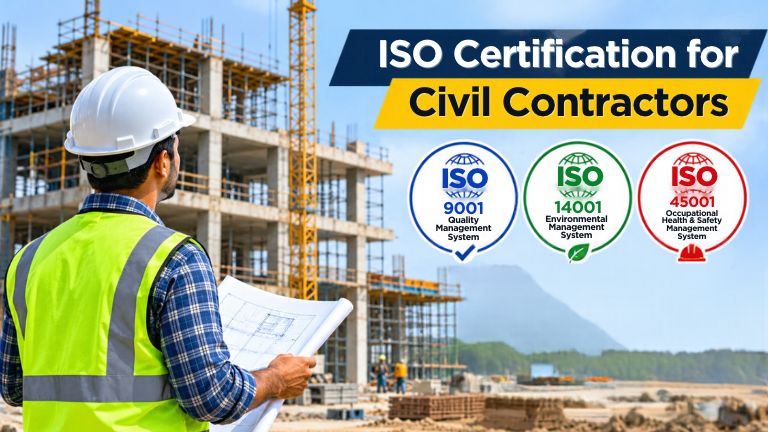
The civil construction industry plays a significant role in infrastructure development, economic growth, and urban expansion. From residential buildings and commercial complexes to highways, bridges, and industrial projects, civil contractors are responsible for delivering quality construction while maintaining workplace safety and meeting regulatory requirements.
However, increasing competition, rising customer expectations, and strict tender requirements have made it essential for construction companies to adopt internationally recognised management standards.
ISO certification for civil contractors helps construction businesses improve project quality, reduce operational risks, strengthen workplace safety, and establish credibility in the market. It can also help contractors demonstrate their management capabilities when applying for government and private construction tenders.
Whether you operate a small civil contracting firm or a large infrastructure development company, implementing relevant ISO standards can support sustainable business growth.
What Is ISO Certification for Civil Contractors?
ISO certification for civil contractors is an independent assessment of a construction company's management system against the requirements of a relevant International Organization for Standardization (ISO) standard.
It demonstrates that the organisation has established management practices to address areas such as construction quality, environmental responsibility, occupational health and safety, and operational efficiency.
ISO certification can help civil contractors improve:
Construction quality management
Project planning and execution
Workplace health and safety
Environmental management
Construction material management
Risk assessment and operational controls
Customer satisfaction
Regulatory compliance management
ISO develops international standards, while independent certification bodies conduct audits and issue certificates.
Which ISO Certification Is Best for Civil Contractors?
Civil contractors can obtain different ISO certifications depending on their business activities, project requirements, operational risks, and client expectations.
1. ISO 9001 – Quality Management System
ISO 9001 certification is one of the most relevant certifications for civil contractors. It focuses on establishing an effective Quality Management System (QMS) to improve process consistency and customer satisfaction.
Construction companies can use ISO 9001 to improve material inspections, project documentation, supplier evaluation, workmanship, and quality control procedures.
Key benefits include:
Improved construction quality
Reduced material wastage
Better supplier management
Fewer construction defects
Improved customer satisfaction
Standardised operational procedures
ISO 9001 certification is particularly beneficial for contractors seeking government and corporate construction projects.
2. ISO 14001 – Environmental Management System
Construction activities can generate dust, noise, waste, pollution, and other environmental impacts. ISO 14001 certification helps civil contractors establish an Environmental Management System (EMS) to manage these challenges.
It supports responsible construction practices through improved waste management, resource utilisation, pollution prevention, and evaluation of environmental compliance obligations.
Civil contractors working on infrastructure and industrial construction projects can benefit significantly from implementing environmental management standards.
3. ISO 45001 – Occupational Health and Safety Management System
Construction sites involve occupational hazards such as working at heights, electrical risks, heavy machinery, excavation, and material handling.
ISO 45001 certification helps civil contractors identify workplace hazards, assess occupational risks, and implement appropriate safety controls.
It also supports employee participation, safety training, emergency preparedness, incident investigation, and continual improvement of workplace safety.
Implementing ISO 45001 can help construction companies reduce workplace accidents and create safer working environments.
4. ISO 50001 – Energy Management System
ISO 50001 certification helps construction businesses improve energy performance and manage energy consumption.
Civil contractors operating heavy machinery, construction equipment, manufacturing facilities, and large infrastructure projects can implement this standard to improve energy efficiency and reduce unnecessary operating expenses.
5. ISO 37001 – Anti-Bribery Management System
Civil contractors frequently participate in tendering, procurement, subcontracting, and commercial negotiations.
ISO 37001 certification helps organisations establish controls to prevent, detect, and address bribery risks. It can support transparent business practices and strengthen organisational governance.
Types of Civil Contractors Eligible for ISO Certification
|
Type of contractor
|
Recommended ISO standards
|
|
Building construction contractors
|
ISO 9001, ISO 45001
|
|
Road and highway contractors
|
ISO 9001, ISO 14001, ISO 45001
|
|
Bridge construction companies
|
ISO 9001, ISO 45001
|
|
Infrastructure development companies
|
ISO 9001, ISO 14001, ISO 45001
|
|
Industrial construction contractors
|
ISO 9001, ISO 45001, ISO 50001
|
|
Residential construction companies
|
ISO 9001, ISO 45001
|
|
Government civil contractors
|
ISO 9001, ISO 14001, ISO 45001
|
|
Excavation and earthwork contractors
|
ISO 14001, ISO 45001
|
|
Plumbing and drainage contractors
|
ISO 9001, ISO 14001
|
|
Engineering and EPC contractors
|
ISO 9001, ISO 14001, ISO 45001
|
The appropriate certification depends on the contractor's actual scope of work and management requirements.
Benefits of ISO Certification for Civil Contractors
Improved Eligibility for Construction Tenders
Many government departments, public sector undertakings, and private organisations include ISO certification in their tender eligibility or evaluation criteria.
Obtaining relevant ISO certification can help civil contractors meet such requirements and improve their competitiveness. However, certification does not automatically guarantee tender eligibility or contract approval. Better Construction Quality
A structured quality management system helps contractors establish material inspection procedures, workmanship standards, testing requirements, and project acceptance criteria.
These practices can reduce construction defects, rework, and customer complaints.
Enhanced Workplace Safety
ISO 45001 helps construction companies establish systematic safety procedures, identify hazards, and implement risk controls.
Improved construction site safety can reduce workplace incidents, operational disruptions, and associated expenses.
Increased Business Credibility
ISO-certified civil contractors can demonstrate their commitment to internationally recognised management practices. This can strengthen confidence among customers, developers, investors, suppliers, and business partners.
Reduced Operational Costs
Effective construction management systems help businesses identify inefficient processes, minimise material wastage, improve resource allocation, and reduce unnecessary rework.
These improvements can contribute to better project profitability.
Improved Environmental Performance
ISO 14001 helps contractors manage construction waste, dust emissions, noise pollution, water consumption, and other environmental impacts.
Responsible environmental practices can also support sustainable construction and green infrastructure development.
ISO Certification Requirements for Civil Contractors
Civil contractors must establish and implement a management system that meets the requirements of their selected ISO standard.
Common requirements include:
Defined organisational structure and responsibilities
Management system policies and measurable objectives
Construction quality control procedures
Risk identification and assessment
Supplier and subcontractor evaluation
Employee training and competence management
Equipment maintenance and inspection records
Applicable legal and regulatory compliance management
Internal audits and management reviews
Corrective actions and continual improvement
The exact requirements depend on the applicable ISO standard and certification scope.
Documents Required for ISO Certification for Civil Contractors
Construction businesses may need to provide the following documents and records during the certification process:
Business registration documents
PAN and GST registration details, where applicable
Company profile and organisational structure
Details of construction activities and project locations
Quality, environmental, and safety policies
Employee training records
Construction material inspection reports
Equipment maintenance and calibration records, where applicable
Risk assessment and safety inspection reports
Internal audit and management review records
Applicable licences and statutory approvals
Documentation requirements may vary depending on the certification body, company size, selected standard, and nature of construction activities.
How to Get ISO Certification for Civil Contractors in India
Step 1: Select the Appropriate ISO Standard
Identify the ISO certification that aligns with your construction activities, customer expectations, tender requirements, and business objectives.
Step 2: Conduct a Gap Analysis
Evaluate existing construction management practices against the selected ISO standard to identify areas requiring improvement.
Step 3: Develop and Implement the Management System
Establish relevant policies, operational procedures, responsibilities, risk controls, and documented information. Ensure these practices are implemented across applicable construction activities.
Step 4: Conduct Internal Audits and Management Reviews
Perform internal audits to identify nonconformities and evaluate management system effectiveness. Management should review performance and address identified improvement opportunities.
Step 5: Complete the Certification Audit
An independent certification body generally conducts a Stage 1 audit to assess readiness and a Stage 2 audit to evaluate management system implementation and effectiveness.
Step 6: Obtain ISO Certification
After successful assessment and satisfactory resolution of applicable nonconformities, the certification body makes its certification decision.
The organisation must continue maintaining its management system and undergo periodic surveillance audits.
Cost of ISO Certification for Civil Contractors in India
The cost of ISO certification for construction companies depends on several factors, including:
Selected ISO standard
Number of employees
Number of construction sites
Scope of certification
Complexity of construction activities
Certification body and audit duration
Consultancy and implementation requirements
Civil contractors should request a customised quotation from a reputable certification service provider. When certification is required for tenders, contractors should also verify the applicable accreditation requirements.
Is ISO Certification Mandatory for Civil Contractors?
ISO certification is generally voluntary for civil contractors in India. However, certain government tenders, infrastructure projects, corporate contracts, and procurement policies may require specific ISO certifications.
Contractors should carefully review tender conditions before applying for certification.
ISO certification does not replace statutory construction licences, contractor registrations, labour law obligations, environmental approvals, or other applicable legal requirements.
Conclusion
ISO certification for civil contractors is a valuable investment for construction businesses looking to improve project quality, workplace safety, environmental performance, and market credibility.
Standards such as ISO 9001, ISO 14001, and ISO 45001 help civil construction companies establish effective management systems, reduce operational risks, and strengthen their competitiveness.
By selecting appropriate ISO standards and implementing effective construction management practices, civil contractors can improve customer satisfaction, support tender participation, and create a strong foundation for long-term business growth.
Frequently Asked Questions (FAQs)
1. Which ISO certification is best for civil contractors?
ISO 9001, ISO 14001, and ISO 45001 are generally the most relevant standards for civil construction companies.
2. Can small civil contractors obtain ISO certification?
Yes. Small, medium, and large civil contracting businesses can obtain ISO certification by meeting the applicable standard requirements.
3. Is ISO certification required for government construction tenders?
Some government tenders require ISO certification. Requirements vary depending on the department, project, and tender conditions.
4. What is the validity of ISO certification for civil contractors?
Management system certification generally follows a three-year certification cycle, subject to satisfactory surveillance audits and continued conformity.
5. Can civil contractors obtain multiple ISO certifications?
Yes. Contractors can implement an Integrated Management System (IMS) covering quality, environmental, and occupational health and safety requirements.
ALSO READ