Furniture production involves the use of machines for cutting, compressors, polishing units, drying activities and also for lighting purposes which take considerable amount of energy.The ISO 50001 can help make optimal use of energy since it leads to various benefits which include reduced energy consumption, reduced electricity bills and effective operations.
ISO 27001 – Information Security Management System
A number of furniture manufacturers make use of ERP solutions, CAD designs, customer databases, vendor contracts, as well as export documentation.
ISO 27001 safeguards confidential business data.
Advantages
- Protection of customer data
- Safety of product designs
- Lower risks of cybersecurity attacks
- Improved operational continuity
Benefits of ISO Certification for Furniture Manufacturers
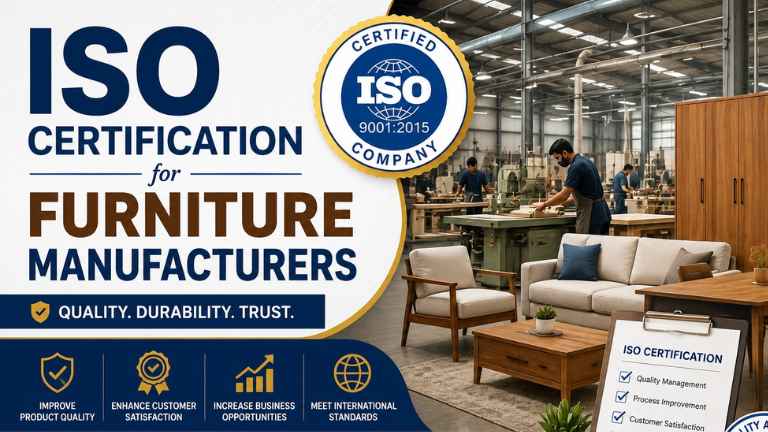
1- Improves product quality
ISO certification helps furniture manufacturers put in place standardized making processes, so quality stays pretty consistent from one item to another. It also lowers the chance of defects shows up, which in turn reduces rework and yes, it usually boosts customer satisfaction
2- Enhances customer trust
Most customers and business partners are more comfortable choosing an ISO-certified manufacturer , mainly because it signals a real commitment to quality, dependable performance and continuous improvement. That tends to strengthen your brand reputation and makes it easier to keep long term relationships going
3- Increases operational efficiency
ISO standards sort of guide and streamline the workflows, they spell out clear responsibilities, and they help optimize how the manufacturing runs. In the end, companies often increase productivity, cut down on delays, and use resources more wisely, with less fuss.
4- Reduces material waste and production costs
When manufacturers apply quality management practices, they can spot inefficiencies earlier, minimize raw material wastage, and limit production mistakes. This usually means more noticeable cost savings and better profitability over time
5- Supports export and international trade
A lot of global buyers, they really do prefer or even just require suppliers to hold ISO certification. When you’re ISO certified, your overall credibility improves in those international markets, so it becomes easier to snag export contracts and basically broaden your customer circle.
6- Improves workplace safety
Standards like ISO 45001 assist manufacturers in building a safer work setting. They do this by spotting hazards in the workplace, lowering the number of accidents, and making sure you’re aligned with occupational health and safety rules. It’s sort of like having a clearer map for risks.
7- Strengthens environmental responsibility
Using ISO 14001, furniture manufacturers can tidy up waste management, lessen their environmental footprint , and start adopting more sustainable production habits. Not only does this help with regulatory compliance, but it also attracts customers who actually care about the planet. So, everybody wins, sort of.
8- Enhances business reputation
ISO certification is a visible signal that your company follows internationally accepted standards. That boosts how your brand is seen in the market, and it makes your business more appealing to customers, investors, suppliers, plus even government agencies.
9- Improves compliance with legal requirements
ISO-certified organizations keep documented processes in place, and they also review compliance with relevant laws and regulations on a regular basis. That lowers the chances of legal trouble, and it keeps day to day operations running smoothly.
10- Provides a competitive advantage
In a furniture market that’s crowded, ISO certification can separate your company from non-certified rivals. It raises your probability of winning government tenders, corporate agreements, and big commercial projects, while also reinforcing customer confidence in what you produce.
Industries That Benefit from ISO Certification
Furniture manufacturers that serve these sectors tend to gain a big advantage
- Residential furniture,
- Office furniture
- Educational furniture,
- Hospital furniture
- Hotel furniture
- Restaurant furniture
- Retail display furniture,
- Modular furniture
- Luxury furniture
- Customized furniture
- Outdoor furniture
- Wooden furniture,
- Metal furniture
- Plastic furniture,
- And interior design companies too, they often benefit a lot from the same kind of support and synergy.
Documents Required for ISO Certification
Conventional documentation includes the following:
- Company registration documents
- GST certification
- PAN card
- Organizational structure
- Manufacturing process flow
- Quality policy
- Standard operating procedures (SOPs)
- Risk assessment records
- Employee training records
- Customer feedback records
- Internal audit reports
- Management review records
ISO Certification Process for Furniture Manufacturers
First Action: Initial Assessment.
The certifying authority analyzes current business activities to establish readiness for certification.
Next Action: Identification of Problems.
Current practices are evaluated against the ISO standards.
Areas needing improvement as a result of the completed analysis are identified.
Next Action: Documentation.
Necessary policies, standards, manuals, and records are created according to ISO requirements.
Next Action: Implementation.
Management system is deployed in all divisions.
Staff is trained to work with the new system.
Next Action: Internal Audit.
Internal auditors will check whether the management system functions properly.
Any identified inconsistencies will be corrected.
Last Action: Senior Management Review.
Management assesses the functioning of the management system and agrees on its improvement actions.
Step 6: Management Review
Management personnel have degraded the performance of the management system and approved improvements.
Step 7: Certification Audit
An accredited certification body has conducted the external audit.
If everything is fulfilled, the organization has been awarded ISO certification.
Step 8: Surveillance Audits
Surveillance audits have taken place now and then for verification of compliance and enhancement of the process.
Common Challenges Without ISO Certification
Furniture manufacturers without standardized systems often face:
- Inconsistent product quality
- Customer complaints
- Material wastage
- Production delays
- Poor documentation
- Low employee accountability
- Export difficulties
- Tender disqualification
- Compliance issues
- Reduced customer confidence
ISO certification effectively addresses these challenges.
How ISO Certification Improves Customer Satisfaction
- Higher quality products
- On-time deliveries
- Quicker resolution of complaints
- Dependable customer support
- Reliable production practices
- Better communication
Customers who are satisfied lead to repeat purchases and referrals.
Cost of ISO Certification for Furniture Manufacturers
The total cost is determined by a lot of different factors, such as:
- Size of the organization
- Number of personnel
- Number of production units
- Type of ISO standard
- Extent of the certification
- The body of certification
- Availability of documentation and level of maturity of the system
While the certification process involves a certain initial outlay, in the long run, the savings due to higher efficiency, reduced waste, and new business opportunities are likely to exceed the initial investment.
Why International Buyers Prefer ISO-Certified Furniture Manufacturers
- Guaranteed Product Quality
For international companies, ISO-certified furniture manufacturers are more appealing since certification guarantees that the products are made in compliance with a standard process in terms of production and quality assurance measures. This lessens the number of defective products and indicates that the product specifications are met.
- Trustworthy Production Methods
ISO certification provides evidence that the manufacturer abides by clear production policies for quality control and for continuous process improvements. Companies appreciate this truthfulness as it guarantees consistent work throughout the complete order volume.
- Compliance with International Rules
A significant number of international markets require compliance with the universally recognized rules of quality and management. ISO certification facilitates the process of compliance with the requirements.
- Compliance with Timeliness Principle and Perfect Supply Chain Coordination
ISO-certified companies use effective production procedures including planning and inventory processes. These strategies guarantee that the orders will arrive on time.
- Ecological Awareness
International clients begin to pay attention to the ecological aspect of cooperation with suppliers. ISO 14001 system indicates that the companies follow ecology-friendly production techniques.
- Quality Workplace Safety Standards
Furniture production presupposes the use of heavy machinery and chemicals.Having ISO 45001 certification indicates that the organization upholds a secure working environment, diminishes operational risks, and advances ethical manufacturing practices that numerous international clients demand from their suppliers.
- Improved Management of Risks
Organizations that possess ISO certifications actively discover and control risks related to manufacturing, performance, suppliers, and customers. This allows reducing the risks of supply interruptions, problems with quality, and delays, increasing customers’ confidence in sustainable cooperation.
- Increased Business Credibility
ISO certification received from an approved certification authority confirms that the company has gone through third-party auditing and complies with the internationally recognized management standards. Thus, it enhances credibility and ensures relationships with international customers.
- More Expeditious Qualification of Suppliers
Numerous multinational firms, as well as importers, have adopted ISO certification as one of the requirements for supplier assessment. Certified furniture producing companies are able to undergo a supplier qualification process much faster, which considerably raises their chances of getting a long-term contract or exporting their products.
- Enhanced Customer Satisfaction and Lasting Relationships
ISO certification highlights continuous improvement and client satisfaction. The company that constantly offers quality goods, communicates effectively with its clients, and responds to their requests builds good relationships with its partners and ensures sustainability.
Tips for Successful ISO Certification
Tips for successful certification process:
- Get top management commitment.
- Get employees involved while implementing those processes.
- Make sure that all processes are properly documented.
- Perform internal audits on a regular basis.
- Take care of any irregularities once identified.
- Always train your staff.
- Keep improving your processes instead of just seeking the certification.
- Get help from a consultant if needed.
Why International Buyers Prefer ISO-Certified Furniture Manufacturers
International customers always seek suppliers able to produce good products and fulfill various ecological and safety requirements.
ISO-certified manufacturers are able to demonstrate the following characteristics:
- Process consistency
- Reliable quality control
- Documented manufacturing practices
- Traceability systems
- Compliance with regulations
- Continuous improvement commitment
All these characteristics make evaluating suppliers easier and help establish long-term business relationships.
Future of ISO Certification in the Furniture Industry
The furniture industry is realizing the significance of embracing automation, utilizing eco-friendly materials, leveraging digital production techniques, and employing global supply chains. Customers appear to have more focus on quality control, environmental responsibility, and ethics of production than before.
To support manufacturers in adjusting to the changing demands of the market, ISO certification gives them a structured framework to follow in giving their services. Businesses that have ISO certification are in a better place to gain higher productivity, implement modern technologies, minimize operational risks, and compete successfully at home and abroad.
Conclusion
ISO Certification has become an integral part of successful sales strategy for furniture producers looking for sustainable development, establishing high-quality processes and being recognized worldwide. Whether it is challenging to produce home, office, modular or bespoke furniture, the introduction of ISO standards allows businesses to improve product quality, enhance processes, secure workplace safety, and restore customer trust.
The competitive situation on the furniture market today makes the ISO certifications essential as they help with the establishment of effective management systems enabling the reduction of costs, raising the quality of products, complying with regulations, and allowing furniture producers to enter global markets.
FAQ
- What does ISO Certification mean for furniture manufacturers?
ISO certification refers to an international certification which confirms that the furniture manufacturer meets management standards in the required areas, such as quality, safety, environmental protection, and improvement. This certification allows for a smooth production of high-quality furniture and creates trust for customers.
- What is the main ISO certification for furniture producing companies?
The most important ISO certification for furniture manufacturers is ISO 9001:2015 which is the international standard of quality management systems. In accordance with the needs of the manufacturing company, one may also obtain ISO 14001 certification which is related to management of the environment and ISO 45001 certification concerning occupational health and safety.
- Is it obligatory to obtain ISO Certification for furniture producing companies?
ISO certification is not compulsory but offered as a voluntary certification. However, ISO certified companies will have higher chances to obtain government contracts, to sell their products to big corporations and to foreign importers.
- What are the advantages of ISO Certification for furniture producers?
ISO certification leads to improvement of product quality and customer satisfaction, to reducing manufacturing errors, to increasing performance efficiency, to supporting export opportunities, to forming a strong brand reputation, and to following all the regulations.
- What is the duration of obtaining ISO Certification?
As ISO certification process may vary depending upon the size of the manufacturing company and upon the complexity of business operations.
ALSO READ