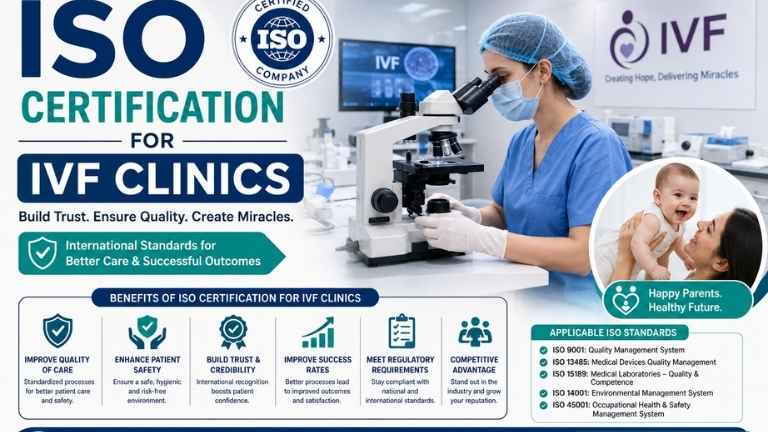
In vitro fertilization (IVF) has changed reproductive medicine by giving hope to more than one million couples who have problems with infertility. The increased number of patients has created rising expectations from clients, public authorities, insurers, and medical tourists. The experience with fertility treatment is now judged not only by pregnancy rate but by patient safety, quality management, ethics, data protection, lab quality, and relevant legislation.
This is the reason why ISO Certification for IVF Clinics comes in handy.
ISO Certification proves that IVF clinic adheres to the worldwide standards of quality, patient care, laboratory management, risk control, and improvement. At all times, it makes the services of clinics reliable and at the same time ensures that the clinic runs smoothly.
Regardless of the fact whether it is a single-center facility or IVF clinic located in various countries, ISO Certification assures the standardization of processes, minimizes errors, improves the work of laboratories, and provides a reputation on the market.
What is ISO Certification?
ISO (International Organization for Standardization) develops international standards that help organizations improve quality, efficiency, safety, and customer satisfaction.
ISO certification indicates that an independent certifying agency has affirmed that the organization operates in accordance with internationally recognized management systems and makes continuous improvement efforts.
In the case of infertility clinics, ISO certification focuses on:
- Patient safety
- Medical quality
- Laboratory accuracy
- Risk management
- Confidentiality
- Process standardization
- Regulatory compliance
- Ongoing improvements
It guarantees that patients experience high-quality health practices in the fertility treatment process.
Why ISO Certification is Important for IVF Clinics
The practice of IVF incorporates modern laboratory operations, costly equipment, private patient information, and the result of their emotional significance.
Even though the smallest of mistakes could lead to treatment failures.
Being ISO-certified enables clinics to put in place a structured process that diminishes the likelihood of errors.
Some reasons for IVF clinics to seek ISO certifications include:
- Progressive expectations of patients
- Foreign patients’ referals
- The emergence of medical tourism
- Global compliance
- Quality assurance
- Better laboratory practices
- Proper documentation
- Fewer mishaps in clinics
- Increased reputation
Common ISO Standards Applicable to IVF Clinics
ISO 9001:2015 – Quality Management System (QMS)
This standard from ISO is the most common.
It supports fertility clinics in the following:
- Uniformity of patient service
- Improvement of fertility process
- Performance tracking
- Reduction of errors in operations
- Gaining patient satisfaction
- Optimizing the work of the staff
ISO 9001 is approved for:
- Reproductive facilities
- IVF clinics
- Facilities for reproductive medicine
- Laboratories for andrology
- Laboratories for embryology.
ISO 15189 – Medical Laboratory Quality and Competence
The embryology laboratory is an integral part of the IVF process.
The essence of ISO15189 is:
- Competent laboratory;
- Reliable examinations;
- Calibration of devices;
- Qualified personnel;
- Proper handling of the materials;
- Quality control;
- Control over the documentation.
Numerous modern IVF clinics must comply with ISO 15198 in order to improve laboratory work.
ISO 27001 – Information Security Management System
IVF centers keep sensitive information which includes:
- Medical records
- Fertility reports
- Genetic information
- Financial records
- Patient identity
- Laboratory data
ISO 27001 protects the sensitive healthcare data by means of implementation of cybersecurity and data safety programs.
ISO 14001 – Environmental Management System
Large fertility hospitals may also implement ISO 14001 to improve:
- Biomedical waste management
- Energy conservation
- Environmental responsibility
- Sustainable healthcare practice
ISO 45001 – Occupational Health and Safety
This standard protects employees by improving:
- Workplace safety
- Hazard management
- Chemical handling
- Laboratory safety
- Emergency preparedness
Benefits of ISO Certification for IVF Clinics
Builds Patient Trust and Assurance
The process of infertility treatment has both a psychological and economic significance for the patients. In choosing an IVF clinic that is accredited by ISO, clients can be assured that it complies with the recognized quality management system. It effectively increases their confidence in the clinic in terms of patient safety, methods followed for treatment, and consistency in delivering healthcare services.
Enhances the Quality of Care Given to Patients
ISO Certification makes it possible to have standardized processes for each stage in a treatment of fertility like patient consultations, diagnosis, ovarian stimulation, egg retrieval, embryo culturing, embryo transfer, and post treatment observation. It is ensured by the availability of the standardized clinical protocols which minimizes the number of variations in treatment and guarantees high quality of service provided to patients.
Enhances Laboratory Quality and Consistency
Embryology and andrology labs play an important role in the outcome of the IVF process. Compliance with the requirements of ISO involves such laboratory practices as tight quality control of the laboratory, calibration of the equipment used, environmental control, ensuring traceable samples, and providing proper handling of the eggs and embryos which decreases the possibility of laboratory mistakes and enhances.
Decreases Clinical Hazards and Errors
ISO uses a risk-based method which helps IVF clinics to discover, evaluate, and control possible risks beforehand in order to prevent them from affecting care to patients. Either those risks referring to lab operations, patient identification, medication use, or equipment failure, preventive risk treatment helps eliminate mistakes and enhance treatment security.
Unifies Clinical and Administrative Procedures
ISO Standard even starts from registering patients and finishing with billing and record keeping and defines clear Standard Operating Procedures (SOPs) in all departments of the clinic. Such unification of scientists' work-flow leads to better communication and removes delays, mismatches in activities, improves efficiency of the facility.
Improves Documentation and Record Keeping System
Documentation is extremely important in reproduction medicine. The ISO certification ensures coherent management of patients' records, treatment protocol, consent forms, lab reports, reports about equipment maintenance, auditing papers, and even job records.
Advances Compliance with Regulations
For their part, IVF Clinics must adhere to various laws and regulations. ISO Certification provides clinics with the means of setting up documented procedures in compliance with the relevant health regulations, licensing requirements, biomedical waste disposal instructions, and patient security measures.
Maximizes Data Protection and the Security of Patient Data
IVF Hospitals have to carry out numerous functions involving highly sensitive information such as health histories, fertility analyzes, genetic information, and finance-related data. In their endeavor to make sure that the data remains secured, clinics can conduct security control procedures, especially by means of the ISO 27001.
Facilitates Efficiency of Operation
Clearly articulated responsibilities, written procedures, and continual control over processes allow eliminating potential operational inefficiency in the hospital. An improved workflow management system reduces wait times and maximizes process utilization, thereby ensuring increased productivity.
Stimulates Continuous Improvement
One of the principles of the ISO standards is the fact that improvements should be made constantly. IVF hospitals regularly analyze patients’ feedback, results of internal audits, treatment results, corrective measures have been taken, and operational results to determine the ways for improvement.
Documentation Required
Documentation typically includes:
- Quality Manual
- Quality Policy
- Organizational Structure
- SOPs
- Risk Register
- Patient Consent Forms
- Laboratory Procedures
- Equipment Calibration Records
- Maintenance Logs
- Staff Training Records
- Internal Audit Reports
- Corrective Action Reports
- Patient Feedback Forms
- Complaint Register
- Emergency Procedures
- Document Control Records
ISO Certification Process for IVF Clinics
Step 1: Understand the Applicable ISO Standard
First, the appropriate ISO standard must be identified in relation to the clinic’s functioning. Commonly implemented ISO standards in IVF clinics are:
- ISO 9001:2015 – Quality Management System (QMS)
- ISO 15189 – Medical Laboratories – Requirements for Quality and Competence
- ISO 27001 – Information Security Management System (ISMS)
- ISO 45001 – Occupational Health and Safety Management System
- ISO 14001 – Environmental Management System
Most of the IVF clinics start with the ISO 9001 certification and then go for different standards depending on their requirements in laboratories, information security, or environmental management.
Step 2: Conduct a Gap Analysis
A detailed gap analysis has been conducted that assesses how the existing systems of the clinic compare with the requirements of the chosen ISO standard. The assessment pinpoints the areas that must be improved, namely:
- Clinical procedures
- Lab processes
- Patient records
- Risk management procedures
- Equipment maintenance
- Information security measures
- Employee training
- Internal processes
The results obtained from the gap analysis can be used to draw up a plan for implementation.
Step 3: Develop Documentation
To ensure consistency and accountability, it is necessary to have policies and procedures written down. At this point, the clinic will finalize the following vital documents:
- Written quality manual,
- Written quality policy and objectives,
- Written Standard Operating Procedures (SOPs),
- Written risk assessment register,
- Written consent forms,
- Written laboratory instructions,
- Written procedures for maintaining and fixing the equipment,
- Written infection control instructions,
- Written procedures for handling complaints,
- Written emergency plans,
- Written procedures for internal audit,
- Written document control system.
Good documentation guarantees that all departments adhere to standardized procedures
Step 4: Implement the Quality Management System
After all documentation is done, an administration system is implemented in all the departments of the clinic. This means applying ISO requirements to normal operations:
- Patient registration and consultation
- Diagnosis
- IVF procedures
- Laboratory work
- Pharmacy operations
- Medical records
- Billing
- Waste disposal
Doctors will be taught how to carry out the procedures.
Step 5: Employee Training and Awareness
Successful ISO implementation requires employees being properly acquainted with their responsibilities. Training programs provide knowledge to:
- Fertility specialists
- Embryologists
- Nurses
- Laboratory technicians
- Counselors
- Administrative staff
- Quality management personnel
Training includes methods of quality objectives, documentation, patient safety, laboratory guidelines, risk management, and continuous quality protocols.
Step 6: Conduct Internal Audit
Before applying for certification, the clinic performs an internal audit to evaluate whether the implemented management system complies with ISO requirements.
The internal audit examines:
- Compliance with SOPs
- Documentation accuracy
- Laboratory practices
- Equipment maintenance records
- Patient records
- Staff competency
- Risk management activities
- Corrective action implementation
Any non-conformities identified during the audit are documented and corrected before the external audit.
Step 7: Management Review Meeting
Senior management reviews the effectiveness of the implemented management system. The review typically includes:
- Internal audit findings
- Patient feedback
- Clinical performance indicators
- Laboratory quality metrics
- Corrective and preventive actions
- Risk assessments
- Resource requirements
- Improvement opportunities
Management ensures that the system remains effective and aligned with the clinic's quality objectives.
Step 8: Choose a recognized certification body
An independent and recognized ISO certification body is chosen by the clinic to perform the external audit. The certification body should have good reputation and should be experienced in the healthcare industry.
Step 9: Stage 1 certification audit
First stage of the audit is carried out by the certification body and its focus is the review of clinic documents.
During the audit the auditor checks:
Quality manual
- Policies and Procedures
- Scope of Certification
- Risk Management documents
- Readiness for compliance
- Planning for implementation.
Should any documents be lacking, the clinic gets the opportunity to tackle the problem at this stage.
Step 10: Stage 2 certification audit
This stage includes a visit of the auditors to the clinic and they check the practical application of QMS.
Generally the audit includes:
- Inspection of departments
- Observations of processes in laboratories and clinics
- Interviews with staff
- Checking patient's records
- Checking of maintenance of equipment
- Control of laboratory quality
- Checking of training records.
- The auditors determine whether ISO processes were maintain.
Challenges During ISO Implementation
Common challenges include:
- Resistance to procedural changes
- Maintaining detailed documentation
- Training healthcare professionals
- Integrating quality systems with clinical workflows
- Time constraints
- Managing continuous compliance
- Resource allocation
With strong leadership and staff involvement, these challenges can be effectively managed.
Best Practices for Successful ISO Certification
- Develop clear Standard Operating Procedures (SOPs).
- Encourage staff participation in quality initiatives.
- Conduct regular internal audits.
- Review patient feedback consistently.
- Maintain equipment calibration schedules.
- Protect patient data with robust security controls.
- Provide ongoing staff training.
- Monitor key performance indicators (KPIs).
- Update documentation regularly.
- Foster a culture of continual improvement.
How ISO Certification Improves Patient Experience
Patients benefit from:
- Transparent treatment processes
- Better communication
- Reduced waiting times
- Consistent service quality
- Enhanced confidentiality
- Reliable laboratory practices
- Faster complaint resolution
- Improved safety standards
These improvements contribute to higher patient satisfaction and long-term trust.
Future of Quality Management in Fertility Healthcare
The fertility healthcare sector is rapidly embracing cutting-edge technologies such as artificial intelligence, digital health records, automation, and precision medicine. The significance of structured quality management systems in ensuring safety, consistency, and compliance will grow as these innovations become more prevalent.
Integrated ISO-certified IVF clinics can better manage new technologies, while also maintaining robust governance, patient information protection and continuing improvements to clinical outcomes. The adoption of internationally recognized standards can enhance credibility and foster sustainable growth, particularly for clinics seeking international collaborations or expanding medical tourism services.
Conclusion
IVF Clinics must obtain ISO Certification as a means of achieving quality, patient safety, operational excellence and long-term success. This is more than just compliance. By utilizing management systems with international recognition, IVF clinics can standardize clinical and laboratory procedures to improve documentation efficiency, protect sensitive patient information, and establish greater confidence in the relationships between patients and healthcare providers.
In the face of a fiercely competitive fertility care market, obtaining ISO certification indicates that delivering top-notch, ethical, and dependable reproductive healthcare is crucial for sustaining entrepreneurship. Whether to enhance patient satisfaction, improve laboratory performance, achieve regulatory readiness or draw international patients, ISO certification provides a solid foundation for sustainable growth and continuous improvement.
FAQ
- How does ISO Certification help IVF Clinics?
IVF Clinics can achieve ISO Certification, an internationally recognized certification that confirms a clinic's implementation of standard quality management systems, patient safety practices and laboratory controls, as well as continuous improvement processes. This ensures that fertility care is reliable, consistent, and of high quality.
- Which ISO code is considered the most suitable for IVF clinics?
The standard that is widely accepted is ISO 9001:2015 (Quality Management System). ISO 15189, ISO 27001 and ISO 45001 are varying standards for medical laboratories, information security, occupational health and safety, and environmental management, depending on the clinic's services.
- Is ISO Certification necessary for IVF clinics?
It is generally accepted that ISO Certification is not mandatory. Nevertheless, it's highly valued due to its capacity to improve office productivity, enhance patient confidence, support regulatory compliance, and reinforce the clinic'reputation in the healthcare sector.
- What are the perks of having ISO Certification for an IVF clinic?
The benefits of ISO Certification are numerous, including:
- Improved patient trust and satisfaction.
- Standardized clinical and laboratory procedures.
- Better risk management.
- Enhanced data security.
- Reduced operational errors.
- Improved documentation and record management.
- Greater confidence on the domestic and foreign healthcare markets.
- What is the time frame for ISO Certification when it comes to IVF clinics?
Certification takes anywhere from 2 to 6 months depending on the size of the clinic and the state-of-the-art systems used for managing its operations, documentation readiness or compliance with the ISO standard being implemented.
- What are the necessary documents for obtaining ISO Certification?
Typical documentation includes:
- Quality Manual.
- Quality Policy and Objectives.
- Standard Operating Procedures (SOPs)
- Patient consent forms.
- Risk assessment records.
- Equipment maintenance and calibration logs.
- Staff training records.
- Internal audit reports.
- Corrective action reports.
- Patient feedback and complaint records.
- In what ways does ISO Certification enhance patient safety in IVF clinics?
ISO Certification involves the use of standard procedures for identifying patients, controlling infection, managing laboratories, maintaining equipment, taking precautions, dealing with risks, and reporting incidents. These steps help to reduce errors and improve the safety and reliability of fertility treatments.' But more.
- Can ISO Certification be considered an asset to the IVF field?
Pregnancy and success rates are not positively impacted by ISO Certification. In spite of this, it raises the quality and consistency of clinical and laboratory procedures, decreases procedural errors, improves equipment upkeep, and strengthens quality control, all of which contribute to better treatment outcomes.
- Do small IVF clinics meet ISO Certification requirements?
Yes. Small, medium, and large IVF clinics can all be ISO Certified. A scalable system of management can be tailored to the clinic's size, services, and business operations.
- Can you provide information on the ISO Certification fee for IVF clinics?
The cost fluctuates due to various factors, including:
Clinic size.
- Number of employees.
- Number of locations.
- Applicable ISO standards.
- Certification body.
- Scope of certification.
- A professional ISO consultant can offer a customized quote after considering the clinic's requirements.
ALSO READ