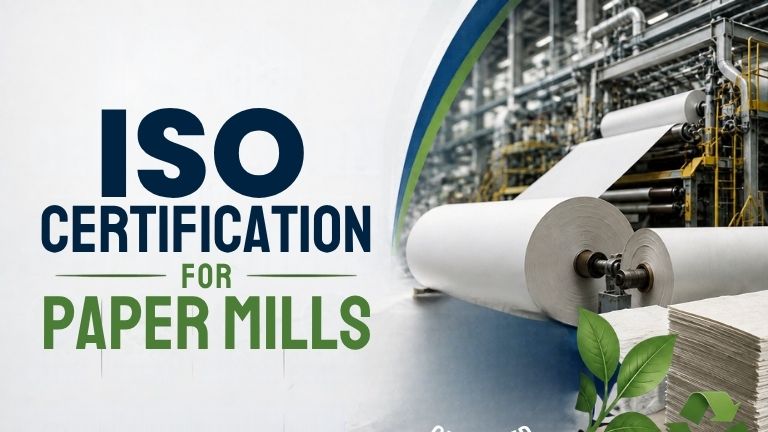
The paper production sector is essential for industries such as education, packaging, printing, publishing, healthcare, e-commerce, and consumer products. With the tightening of environmental rules and customer demands today, paper manufacturing firms must focus on producing the highest quality paper while minimizing the environmental damage. One of the viable methods of accomplishing such objectives is obtaining ISO Certification.
ISO Certification proves that a paper producer adheres to the international standards regarding quality, environmental management, occupational safety, and efficiency of operations in its factories. It guarantees lower production costs and improved customer satisfaction.
No matter the kind of paper produced by a particular paper mill – writing paper, kraft paper, tissue paper, newsprint, specialty paper, packaging paper, or recycled paper, ISO certification has proved itself to be beneficial as it gives the company a competitive edge over its rivals.
What is ISO Certification?
ISO certification refers to an internationally acknowledged accreditation indicating that an organization has put in place management systems that meet universally accepted standards.
ISO certified paper mills are assured of proper control of the production process, fulfilling customer requirements, maintaining environmental protection, and ensuring workplace safety.
ISO applies a process-centric approach through which it evaluates the entire management system rather than simply focusing on the quality of the product.
Why ISO Certification is Important for Paper Mills
Manufacturing paper can be complicated due to the variety of steps like obtaining raw materials, pulping, bleaching, drying, coating, finishing, packaging, and distributing the final product. Any inconsistency at any stage can lead to deterioration in quality and increased costs.
With ISO Certification, paper mills can have standardized processes in place to reduce defects and improve efficiency.
This certification has several benefits, such as:
- Consistent quality of the final product
- Less production defect
- Higher customer satisfaction
- Better environmental management
- Higher workplace safety
- Increased efficiency in operations
- International recognition
- Support in improving exports
- Lower production costs
- Continuous improvement of processes
Types of ISO Certifications for Paper Mills
ISO 9001:2015 – Quality Management System
ISO 9001 is the globally famous quality management standard that is found throughout the world. ISO 9001 is useful for paper manufacturers as it enables them to create orderly quality management systems that facilitate better quality and increase customer satisfaction.
The advantages are:
- Standardized manufacturing process
- Improved product quality
- Increased customer satisfaction
- Reduced errors in production
- Effective management of quality
- Continuous development
ISO 14001:2015 – Environmental Management System
Manufacturing paper uses large amounts of water, energy, and natural resources. ISO 14001 helps various businesses minimize their negative impact on the environment through effective environmental practices.
Key advantages
- Effective waste disposal
- Less pollution of the environment
- Enhanced water conservation
- Optimized energy consumption
- Compliance with environmental laws
ISO 45001:2018 – Occupational Health and Safety Management System
In paper production factories, there are significant pieces of machinery made of metal, and many harmful chemicals which form a more dangerous environment. ISO 45001 was created to help organizations to create a safer place of work and protect both workers and employers from accidents.
Advantages
- Fewer workplace accidents
- Better hazard identification
- Employee safety training
- Emergency preparedness
- Greater confidence in workers
- Rules and regulations compliance
ISO 50001 – Energy Management System
Energy costs represent a significant portion of paper manufacturing expenses.
ISO 50001 helps organizations:
- Monitor energy consumption
- Improve energy efficiency
- Reduce operational costs
- Lower carbon emissions
- Support sustainable manufacturing
ISO 27001 – Information Security Management
Modern paper mills increasingly rely on ERP systems, production software, customer databases, and digital supply chains.
ISO 27001 helps protect:
- Customer information
- Financial records
- Production data
- Business intelligence
- Confidential documents
Benefits of ISO Certification for Paper Mills
Consistent Product Quality
To ensure that every production batch of paper meets consumer requirements in terms of thickness, strength, brightness, moisture content, smoothness, and durability, ISO 9001:2015 enables paper mills to create a comprehensive Quality Management System, which streamlines production and quality control processes. Thus, consistent quality of products minimizes customer complaints, decreases number of rejected products, and improves reputation of the brand.
Improved Customer Satisfaction
In terms of long-term development of business, customer satisfaction plays a key role. Paper mills that have ISO certification strive to know their customers, track their feedback, and improve their products and services.
Enhanced Operational Efficiency
ISO certification leads to documentation and optimization of production processes in paper-making companies. Standardized processes remove inefficiencies and help to enhance productivity of companies.
Reduced Production Waste
The production of paper requires a substantial amount of raw materials, water, energy, and chemicals. ISO standards promote better resource making.
Enhanced Environmental Performance
ISO 14001:2015 allows paper manufacturing companies to maintain an effective Environmental Management System (EMS). It assists companies in detecting environmental risks, cutting down pollution levels, enhancing wastewater treatment, conserving natural resources, and fulfilling environmental laws.
Furthermore, the demonstration of environmental accountability boosts the company’s reputation amongst customers and stakeholders.
Improved Workplace Health and Safety
Paper manufacturing organizations use heavy machinery, boilers, conveyors, and chemical processing systems that can create hazards within the workplace. ISO 45001:2018 helps companies discover risks, take preventive measures, and create safer workplaces.
Some benefits include:
- Reduced number of accidents at the workplace
- Improved emergency preparedness
- Increased employees’ awareness
- Less downtime due to injuries
- Boosted morale among employees
Compliance with Legal and Regulatory Requirements
ISO certifications help the producers of paper abid by all the possible regulations at a national and international level that relate to quality, environmental safety, occupational health and safety, and industrial operations.
Compliance with regulations decreases the possibility of incurring legal penalties, operational problems, and loss of reputation.
Increased Export Options
Numerous international buyers prefer or require the suppliers to obtain ISO certification prior to forming business relationships.
Improved Brand Image
The ISO certification provides assurance regarding the quality, reliability, and professionalism of products and services. It reassures customers and makes paper mills stand out from those organizations that lack global certification.
A positive reputation of a firm leads to attracting new clients, investors, as well as business partners.
More Effective Risk Control
The ISO standards prompt companies to find risks in their operations, assess risks beforehand, and take precautions against risks before they emerge.
The implementation of the above-mentioned system helps paper mills avoid production interruptions, malfunctions in machines, and non-compliance issues.
ISO Certification Process for Paper Mills
The process of obtaining ISO certification is systematic and helps paper mills implement internationally accepted management systems for quality, environmental responsibility, safety at work, and efficiency of operations. Paper mills might choose any of the following standards in the certification process: ISO 9001 (Quality Management System), ISO 14001 (Environmental Management System), ISO 45001 (Occupational Health and Safety Management System), or ISO 50001 (Energy Management System).
The section below describes the systematic process of obtaining ISO certification for paper mills.
Step 1: Identify the Appropriate ISO Standard
Initially, it is crucial to find the most suitable ISO certification that fits with the goals and requirements of the operation of the paper mill. Since each standard focuses on a different aspect of business.
For example:
- ISO 9001:2015 - Quality Management System
- ISO 14001:2015 - Environmental Management System
- ISO 45001:2018 - Occupational Health and Safety Management System
- ISO 50001:2018 - Energy Management System
Several paper mills decide to implement numerous ISO standards at the same time through an Integrated Management System.
Step 2: Perform a Gap Analysis
The gap analysis examines how the current operation of the paper mill aligns with the requirement(s) to conform to the ISO standard in question.
At this stage, the organization will examine:
- The manufacturing processes currently in use
- Quality control systems
- Environmental practices
- Occupational safety practices
- Information systems
- Regulatory compliance requirements
The conclusion of this step will highlight areas for improvement.
Step 3: Create an Implementation Plan
At this point, taking the issue analyzed above into account, the mill will prepare a detailed plan that will include the following elements of the implementation, namely:
- Plan objectives
- Scope of the system
- Responsibilities
- Implementation timetable
- Resource management
- Training issues
- Risk management
A good plan will facilitate successful and smooth implementation of the above issue.
The fourth stage is the documentation. It is one of the most important aspects of the certification process.
Step : 4
Documentation comprises various documents created and maintained by different paper mills. It includes:
- Quality Manual,
- Health and Safety Policy
- Environmental Policy
- Standard Operating Procedures (SOPs), Work Instructions
- Risk Assessment Reports
- Process Flow Charts
- Equipment Maintenance Records,
- Supplier Evaluation Records,
- Training Records,
- Internal Audit Reports,
- Corrective Action Reports, etc.
Successful documentation ensures improved consistency, traceability, and confidence in compliance with ISO certification.
The fifth stage is the implementation of the ISO management system. After completing documentation, ISO management system deployment begins.
Implementation involves:
- complying with the SOPs,
- monitoring production quality,
- controlling environmental impact,
- ensuring workplace safety,
- keeping records of operations, etc.
The implementation is successful on the condition of active involvement of the staff.
The sixth stage involves the development of employee awareness concerning the company and ISO requirements.
Step 6: Perform Internal Audits
Prior to submitting an application for certification, the paper mill needs to perform internal audits to assess the compliance of the management system with the ISO standards.
Internal audits provide information on:
- Non-compliance
- Poor documentation of the process
- Problems within the processes
- Compliance issues
- Possible areas for improvement
All the corrective actions are to be taken before an external audit takes place.
Step : 7 Management Review
Top management carries out a review of the management system’s performance to ensure that it meets its purpose.
The review will normally include:
- Results of the internal audit
- Comments from the customers
- Efficiency of each process
- Environmental performance
- Safety performance
- Risks
- Improvement opportunities
Step 8: Management Review
Top management assesses the performance of the management system, ensuring that it is delivering effective results and complying with the business objectives.
Usually, the review comprises:
- Internal audit results
- Feedback from customers
- Performance of processes
- Performance in the field of environment
- Safety performance
- Risk analysis
- Possibility of improvements
- Resources required
The commitment of management is very important to achieve ISO compliance and continuous improvement.
Step 9: Audit by the Certification Body
After successfully implementing the management system and conducting the internal evaluation, the paper mill approaches a certification body and requests certification audit.
- The certification audit involves two steps:
- Step 1 Audit – Documental review
The auditors examines all the documents, ensuring that they meet the requirements of the relevant ISO standard.
The documents include:
- Policies
- Procedures
- Manuals
- Records
- Scope of certification
- Documentation on the management system
All discrepancies found in this step must be resolved before proceeding to the next step.
Step 2 Audit – Site Assessment
During the second stage, the auditors visit the paper mill in order to check how efficiently the management system has been implemented.
They evaluate:
- Production process
- Control of the quality
- Environmental management
- Awareness of employees
- Safety measures
- Equipment maintenance
- Keeping record of operations
Documentation Required
Paper mills typically require:
- Quality Manual
- Environmental Policy
- Health & Safety Policy
- Organizational Structure
- SOPs
- Production Records
- Calibration Records
- Inspection Reports
- Supplier Evaluation Records
- Employee Training Records
- Risk Assessment Reports
- Corrective Action Reports
- Internal Audit Reports
- Management Review Minutes
- Customer Complaint Records
Common Challenges During ISO Certification
Lack of Understanding of ISO Standards
Most paper mills have limited understanding of ISO standards and their requirements. Workers and management do not have a proper understanding of the documentation, procedures and requirements for compliance, thus causing a delay in the implementation.
Poor Documentation
ISO certification is highly dependent on proper documentation. This includes quality manuals, policies, SOPs, instructions, records and reports. It becomes extremely difficult to prepare and keep documentation accurate, especially if an organization has never implemented the management system.
Resistance to Change
In many cases, new procedures and quality management practices require changes in daily operational processes. Employees do not want to change their daily activities and embrace new procedures.
Low Commitment from Management
Successful ISO certification is dependent on the active involvement of top management. If the management does not provide adequate guidance and support, the process will be delayed and will lack effectiveness.
Failure to Train Employees
Employees who are not acquainted with ISO standards face difficulties in understanding their duties and responsibilities inside the management system. Insufficient training will lead to problems with implementation and non-conformities during audits.
Why International Buyers Prefer ISO-Certified Paper Mills
Buyers from around the world look for suppliers that can provide high-quality products, as well as comply with environmental and regulatory requirements. Paper mills that are ISO-certified are known to use standardized production processes; perform quality control; provide acceptable levels of environmental management; as well as being compliant with safety rules and standards required at workplaces.
In addition, certification is such a factor that assures buyers that they can trust the supplier when it comes to products manufactured in a timely manner, delivered in timely manner, and internationally certified.
Future of ISO Certification in the Paper Industry
There is a trend in the paper industry that is on the rise due to a growing demand for environmentally friendly manufacturing, the use of recycled paper, as well as quality control in production.
The following trends will continue to emerge in the next period:
The use of automation in the manufacturing process and embracing Industry 4.0.
The use of recycled materials
- Smart systems for quality control
- Efforts to reduce carbon dioxide emissions
- Practices related to usage of circular economy
- Environmentally friendly production processes
- Green technologies in manufacturing processes.
- Use of artificial intelligence in production optimization
ISO certification is very important for paper production plants' adaptation to the new trends and staying competitive in the global market.
Conclusion
ISO certification represents a good opportunity for paper mills that would like to pay more attention to their products’ quality and to increase their efficiency of work and provide protection of the environment while ensuring safety in the workplace. Making use of the internationally recognized standards such as ISO 9001, ISO 14001, ISO 45001, and ISO 50001 will help paper manufacturers improve the quality of work, cut costs, comply with regulations, and enjoy a good reputation.
With the need for companies to produce more environmentally friendly products, ISO-certified paper mills will have more opportunities to enter the international market and develop long-lasting business relations with buyers from all over the world. Having the ISO certification, regardless of the industry (publishing, packaging, tissue, or special paper production), is a guarantee of the paper manufacturers’ commitment to the high quality of their products, constant improvement of the processes, and responsible production.
ALSO VISIT OUR KEY SERVICES