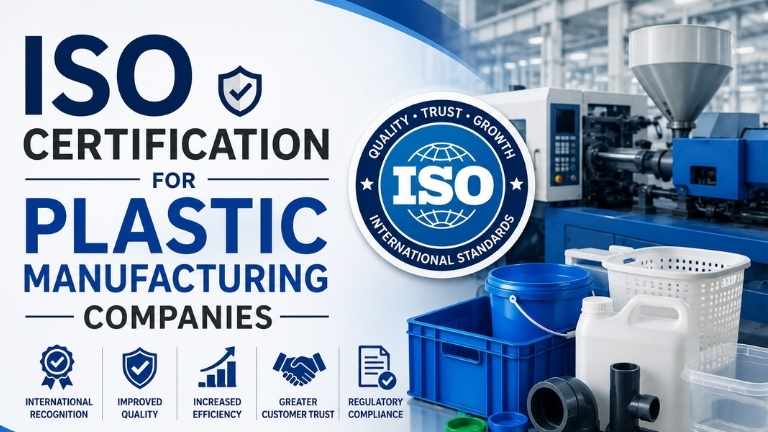
For today’s world, one of the
fastest-growing industries is that of the plastics manufacturing sector
supplying services to many different branches such as healthcare, automotive,
construction, agriculture, production of electronics, and consumers’ items. Due
to the increasing competition, as well as tougher demands in the quality of the
offered products, production companies need to prove the safety, reliability,
and good quality of their output. This is why the businesses in the area of
plastics production should obtain ISO certification.
ISO certification offers plastics
production companies the possibility to standardize their working processes, to
increase their productivity, to reduce waste, to comply with the existing
regulations, and build trust with clients both at home and abroad.
In case your business is associated with
the production of packaging, tubes, bottles, containers, or any type of plastic
product, certification according to the ISO standard will significantly improve
your work.
What is ISO Certification?
ISO
(International Organization for Standardization) Certification is a globally
acknowledged certification that verifies a firm complies with international
management system standards.
It
is important to note that the ISO does not provide product certification but
rather awards its certification based on the organization’s process of
manufacturing a product. ISO assures that organizations successfully implement
their processes ensuring compliance in terms of quality, safety, and
improvement.
ISO
certification is important for the plastic manufacturers since it illustrates
the company's dedication to quality and efficiency in production while taking
care of the environment.
Why
Plastic Manufacturing Companies Need ISO Certification
The
plastic sector has various challenges in today's world, including:
- The need for exact product
specifications
- Expectations of the clients
- Threats to the planet
- Regulations for export
- Stability in raw materials
- Ability to trace the product
- Reduction of waste
- Occupational safety
ISO
certification provides solutions for all of the mentioned challenges.
The
key benefits include:
- Better product quality
- Lower level of defects in
production
- Better customer satisfaction
- More efficient actions of the
company
- Better recognition of the
brand
- More chances to take part in
state bids
- More possibilities for
exporting products
- Meeting international
requirements
Most
Important ISO Certifications for Plastic Manufacturing Companies
1. ISO 9001: Quality
Management System (QMS)
ISO
9001 is the certification that gets the most acceptance from plastic
manufacturers.
It
emphasizes:
- Quality of product
- Control of process
- Customer satisfaction
- Management of risk
- Continuous development
- Documentation of everything
- Monitoring of performance
Appropriate
For:
- Injection molding units
- Blow molding manufacturers
- Plastic packaging companies
- Plastic bottle manufacturers
- PVC pipe manufacturers
- Plastic furniture
manufacturers
- Plastic sheet manufacturers
- Plastic component suppliers
2.
ISO 14001: Environmental Management System
The process of plastic production involves
emissions, waste production, energy utilization, and difficulties in recycling.
ISO 14001 assists organizations in:
- Lessening their impact on the
environment
- Enhancing waste management systems
- Limiting pollution
- Improving resource management
- Enhancing sustainability practices
- Observing environmental laws
This certification is useful for entities that
want to engage in eco-friendly manufacturing.
3.
ISO 45001: A set of standards connected with health and safety.
Plastic production companies usually deal
with:
- Powerful equipment
- High temperatures
- Chemicals
- Equipment used in injection
molding
- Machines used for extrusion.
Obtaining ISO 45001 contributes to making
workplaces safer due to fewer troubles, site danger identification, application
of preventive measures, and compliance with health and safety regulation
observance.
4.
ISO 50001: Energy Management System
Plastic
manufacturing consumes significant electricity and energy.
ISO
50001 enables organizations to:
- Reduce energy costs
- Monitor energy usage
- Improve equipment efficiency
- Lower carbon emissions
- Enhance
sustainability
5. ISO 22000 (For Food-Grade Plastic Packaging)
Companies
manufacturing plastic packaging for food and beverages can benefit from ISO
22000, which ensures food safety management throughout the production process.
Benefits
of ISO Certification for Plastic Manufacturing Companies
1.
Enhanced Quality of Products
ISO
certification ensures quality control procedures that help to manufacture
products with fewer defects, thus ensuring customer satisfaction.
2.
Trust of Customers
Customers
prefer to deal with manufacturers that follow quality practices recognized on a
global level.
ISO
certification boosts the credibility of a business and proves the achievements
of excellent results.
3.
Better Control of Processes
Manufacturing
techniques become better organized due to:
- Appropriate operating procedures;
- Documentation of processes;
- Permanent monitoring;
- Quality control inspections;
As a
result, it reduces mistakes in manufacturing and increases productivity.
4.
Reduction in Production Waste
Plastic
manufacturing leads to a great amount of scrap.
- ISO
systems improve:
- Utilization
of materials;
- Decrease
of waste generation;
- Management
of inventory;
- Recycling
methods;
5.
Enhanced Export Opportunities
The
majority of other companies prefer or require ISO certification from their
providers.
Certification
increases your odds of entering international markets, ensuring compliance with
universal quality standards.
6.
Edge Over Competitors
ISO-certified
producers are able to win over rivals in such areas of their work as
- Vendor registration
- B2B contracts
- Government procures
- Corporate procurement
- Certification can be a decisive factor in selection of
suppliers.
7.
Legal Compliance of Suppliers
ISO
certification helps companies get organized regarding documentation processes
and develop systems that comply with necessary regulations and legal
requirements.
8.
Improved Staff Productivity
Defined
responsibilities, constant training, and regulated processes allow to use the
human resources in the most efficient way and avoid confusion in production.
9.
Permanent Improvement
ISO
quality management system of a company implies regular internal audits,
management reviews, and corrective actions allowing any business to improve its
activities on a permanent basis.
Industries
That Benefit from ISO Certification
The
firms that create plastic for different industries can experience many
benefits. Some of these include:
- Manufacturers of packaging products
- Manufacturers of components for vehicles
- Producers of medical supplies made of plastic
- Manufacturers of pvc pipes
- Creators of plastic furniture
- Suppliers of plastic bottles
- Producers of plastic containers
- Manufacturers of industrial plastic products
- Agricultural producers of plastic
- Producers of electrical parts made of plastic
- Companies that recycle plastic
- Producers of plastic films
Steps
to get ISO certification for plastic manufacturing companies
1.
Initial assessment of the company
Experts
will study your company’s production processes, quality management, and
documentation to know its weaknesses in terms of ISO requirements.
2.
Preparing documents
Among the documents that should be provided are:
- The quality manual;
- Standard operating procedures;
- Instructions for work;
- Risk assessment;
- Company structure;
- Diagrams of production flows;
- Quality policies;
- Environmental policies;
- Safety instructions;
- Forms and records.
3.
Implementing the system
The
procedures outlined should be applied in the production processes, control of
quality, purchasing, maintenance, inventory control, and management.
Training
of workers should be carried out.
4.
Internal audit
An
internal audit should check if the system works properly and find weaknesses of
the quality system.
5.
Review of the management
The
management of the company should analyze the internal audit conducted,
performance indicators, feedback from customers and opportunities for
improvements.
6.
Certification audit
An
external certification agency should perform an independent audit to understand
if the company meets the requirements of the chosen ISO standard.
7.
Receipt of the ISO certificate
After
the audit is complete, the ISO certification will be issued.
Documents Required for ISO Certification
Typically, firms require:
- Company
Registration Certificate
- GST Certificate
- PAN Card
- Factory License
(if applicable)
- Company
Organization Chart
- Product
Information
- Manufacturing
Process
- Quality Manual
- SOPs
- Employee Files
- Maintenance
Records
- Calibration
Sheets
- Audit Reports
- Client Complaints
- Corrective
Actions
Common Challenges Without ISO
Certification
Plastic manufacturers that lack ISO
certification are likely to experience:
- Poor product
quality
- High rates of
rejection
- Complaints from
customers
- Increased costs
of business operations
- Problems with
export orders
- Unavailability of
government tenders
- Ineffective
documentation
- Low levels of
trust among customers
- Weakness in
process control
Use of ISO standards provides solutions
to all of these issues, as it incorporates proper management principles.
How ISO Certification Benefits Exporters
in the Plastic Industry
ISO certification is beneficial to
companies exporting their products overseas for several reasons:
- It creates trust
between an exporter and his foreign customers
- It enables the
qualification of suppliers
- It proves that a
company is compliant with quality standards
- It improves
reliability in the supply chain
- It assists in
documentation and traceability
- It increases
competitiveness in international trade
Even though ISO certification is not
obligatory for international customers, many of them regard it to be one of the
proofs of a reliable company.
Tips to Maintain ISO Certification
After receiving certification, companies
need to:
- Perform periodic internal audits
- Refresh processes continually
- Educate employees on an ongoing basis
- Check for compliance with quality
objectives
- Keep reliable records
- Analyze customer reviews
- Correct non-compliances immediately
- Get ready for all types of audits
Following these practices guarantees the
everlasting compliance and enhancement of improvement.
Conclusion
ISO certification is an advantage for all
companies engaged in plastic manufacturing processes aiming for continuous
development. Following the internationally accepted management systems will
increase the quality of products as well as enhance the level of company
efficiency while reducing waste, improving workplace safety, and meeting all
customers’ and regulatory body’s requirements.
Being either a small factory producing
plastic molding or a big company working all over the world, ISO certification
makes your company more trustworthy on the market and ensures your success in
the long run.
FAQ
What
is the most suitable ISO certification for plastic manufacturing enterprises?
ISO
9001 is the most frequently endorsed standard as it emphasizes Quality
Management. Based on your processes, you could also look into ISO 14001, ISO
45001, and ISO 50001 which can be advantageous.
Is
ISO certification compulsory for plastic producers?
ISO
certification is not obligatory; it is usually voluntary. Nonetheless, numerous
clients as well as government offers and international purchasers tend to rely
on ISO-certified producers.
3.
How long does it take to acquire ISO certification?
It
depends on the size of the business, its preparedness, and the selected
standard. For small and medium manufacturers, the process can sometimes take
weeks or months.
4.
Can ISO certification be achieved by small plastic producers?
Definitely.
ISO standards are flexible enough to suit different companies, irrespective of
their size, including small and medium enterprises and startups.
5.
Does ISO certification provide more chances for export?
For
sure. ISO certification provides legitimacy, assures stable processes, and
widens the possibilities of obtaining a supplier qualification for
international purchasers.
6.
What is the term of ISO certificate validity?
The
ISO certificates are usually valid for three years provided all periodic
surveillance checks by the certification organization are successful.
7.
What are the essential materials needed to apply for ISO certificate?
The
usual documents are company registration data, GST, quality manuals, SOPs, and
the process flow chart etc.
8. Can several ISO standards be adopted
at the same time?
Yes, several producers of plastics have
integrated management systems that utilize ISO 9001, ISO 14001, and ISO 45001
standards simultaneously to yield improved quality and environmental outcomes
and a safe workplace.
9. Is it guaranteed that the product has
been certified with ISO certification?
ISO certification does not confirm the
quality of products; it just shows that the organization has the management
system and processes to consistently produce products that adhere to particular
quality standards.
10. What are the positive effects of ISO
certification for plastic producers over the long haul?
Some of the benefits include increased
efficiency of operations, cost reduction, improvement in trust of customers,
greater engagement of staff, and better compliance, competitiveness, and
sustainability of operations.
ALSO READ-