Gain ISO Certification in Delhi, India with professional help and no stress at all. Enhance your business reputation, increase standards and quality, fulfill the requirements of your industry, and create trust with your customers and business partners..

7,999/-
ISO Certification in Delhi provides an opportunity to your organization to achieve high standard levels and enhance the level of performance. This can be achieved for any kind of industry whether it is startups, SMEs, Manufacturers, Services, Healthcare, Education Institutions, and IT companies. In view of its competitive business climate, ISO Certification in Delhi will improve the credibility of your organization while giving you a greater chance to get more business through government tenders and corporate contracts, both domestically and internationally.
Improves business credibility and brand reputation. · Enhances customer satisfaction. · Increases operational efficiency. · Reduces business risks. · Supports legal and regulatory compliance. · Strengthens market competitiveness. · Creates opportunities for global business expansion.
Some popular ISO standards are: ISO 9001 – Quality Management, ISO 14001 – Environmental Management, ISO 45001- Occupational Health &Safety, ISO 27001 – Information Security, ISO 22000- Food Safety
Get ISO Certification in Delhi to enhance your organization’s performance and achieve sustainable business growth by fulfilling international quality standards.
ISO Certification in Delhi is an internationally recognized standard certifying the quality, safety, efficiency, and regulatory compliance of your organization. Manufacturers, IT companies, Healthcare Providers, Educational Institutions, etc., have begun ISO certification process in Delhi to enhance its standing and performances in the Market.
ISO – International Organization For Standardization has come up with internationally accepted certification standards for the Businesses all over world so that they can organize their business functions, minimize risks, and offer services/goods of certain quality.
As one of the most critical commercial & industrial capital cities in India, there is always an increasing number of businesses wanting to get ISO Certificates because none of the corporations & govt. reps will work with you if you don’t have ISO Certification.
Acquiring an ISO Certification in Delhi offers a myriad of benefits for businesses. From enhanced customer satisfaction to streamlined operations, and from bolstered brand image to efficient risk management, the advantages are manifold. ISO Certification also helps enterprises remain compliant with regulations, paving the way for lucrative new ventures both locally and globally. Whether you're a startup, MSME, or a big organization, getting ISO certified fosters trust with your clientele and other stakeholders, catalyzing the growth trajectory of the entire organisation in a sustainable manner.
To attain ISO Certification, organisations need to follow specific steps that include performing a pre-assessment, documenting their quality management system, implementing ISO standards within their organisation's systems, conducting internal audits, performing management reviews, and ultimately undergoing a third-party audit. Once an organisation achieves ISO Certification, they have to undergo periodic audits to ensure continued conformity with their certification requirements.
Here are some advantages that you will have once you get ISO certification:
ISO Certification Makes Your Business Credible
It improves Customer Satisfaction
ISO Certification helps in making your business efficient
It helps increase competitiveness in the Market – ISO certification is one of the key elements which differentiates you from other competitors in this tough competition market Delhi.
Helps Your Business Become Eligible For Tenders – In today's time almost all the Government as well as private organization requires contracts with ISO certified Organizations.
Opens Many Business Opportunities – ISO Certification boosts up your Overall Reputations And Business Success.
Ensures compliance with legal regulations
Complying with ISO certification means that you are also compliant with the requirements of all relevant legal legislation.
Helps in managing risk
In obtaining an ISO Certification, you will get an opportunity to find out those potential risks that must be avoided. 9) Improves Brand Image and Reputation Getting ISO Certification makes your company become internationally recognized.
Enhances Business Credibility and Trust: One of the biggest advantages of ISO Certification is that it increases your company's credibility. Customers, suppliers, investors, and business partners are more likely to trust organizations that follow internationally accepted quality standards.
For businesses in Delhi, where competition is intense across every industry, ISO Certification acts as proof that your company is committed to maintaining high standards of quality, safety, and customer service. This trust often results in stronger business relationships and increased customer confidence.
Improves Product and Service Quality: ISO standards require businesses to establish structured processes, monitor performance, identify risks, and continuously improve operations. As a result, organizations deliver products and services with consistent quality.
Improved quality helps businesses:
Consistent quality ultimately leads to higher customer retention and positive word-of-mouth referrals.
Helps Win Government and Private Tenders: Many government departments, PSUs, and large private organizations prefer or require vendors to have ISO Certification before awarding contracts.
For businesses operating in Delhi, ISO Certification can improve eligibility for:
Having ISO Certification provides a competitive advantage during the bidding process.
Increases Customer Satisfaction: Customer satisfaction is one of the primary objectives of ISO standards. Certified businesses focus on understanding customer needs, improving communication, resolving complaints efficiently, and maintaining service quality.
Satisfied customers are more likely to:
This directly contributes to sustainable business growth.
Improves Operational Efficiency: ISO Certification encourages organizations to document workflows, eliminate unnecessary processes, reduce waste, and optimize resource utilization.
Improved operational efficiency results in:
This directly contributes to sustainable business growth.
Supports Business Expansion: Many multinational companies and international buyers prefer working with ISO-certified organizations because they follow globally accepted management systems.
For businesses in Delhi planning to expand into new markets, ISO Certification demonstrates that the organization meets international quality requirements. This makes it easier to establish partnerships, attract overseas clients, and enter global supply chains.
Strengthens Risk Management: Every business faces operational, financial, legal, and cybersecurity risks. ISO standards encourage organizations to identify potential risks before they become major problems.
A structured risk management approach helps businesses:
Managing risks proactively minimizes losses and ensures smoother business operations.
Improves Employee Performance: ISO Certification clearly defines employee roles, responsibilities, procedures, and performance expectations. Employees receive proper training and work according to standardized processes.
Benefits include:
A well-trained workforce contributes significantly to overall organizational success.
Enhances Legal and Regulatory Compliance: Businesses must comply with various industry regulations and statutory requirements. ISO Certification helps organizations establish systems that support compliance with applicable laws and regulatory obligations.
This reduces the likelihood of:
Maintaining compliance also strengthens your company's reputation among customers and regulatory authorities.
Creates a Competitive Advantage: In Delhi's highly competitive business environment, customers often compare multiple vendors before making purchasing decisions. ISO Certification helps your business stand out by demonstrating professionalism, quality assurance, and commitment to continuous improvement.
Certified businesses are often perceived as more reliable and trustworthy than non-certified competitors, giving them an edge in attracting new customers and securing long-term contracts.
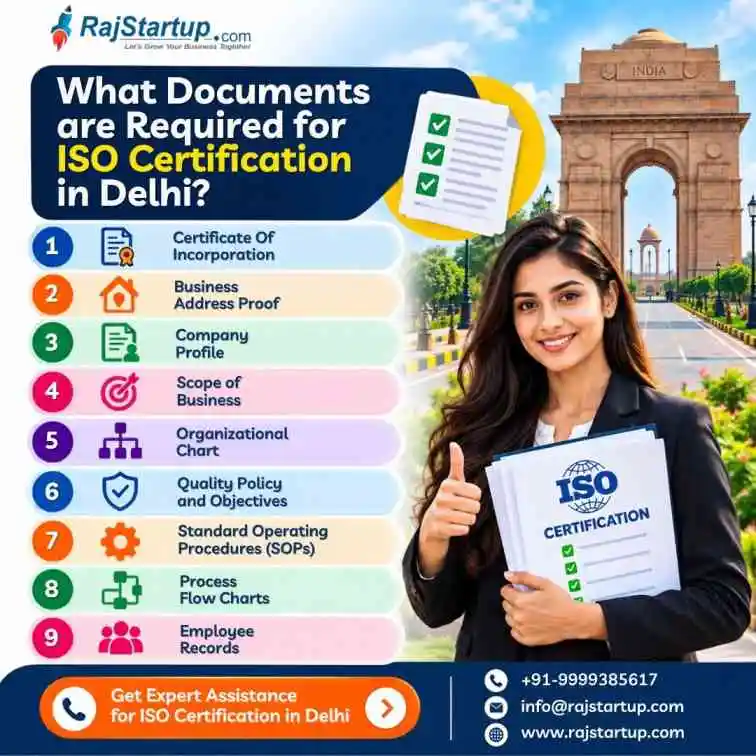
Businesses in Delhi follow several best practices to achieve and maintain ISO Certification successfully. These practices help improve quality, ensure compliance, and enhance operational efficiency.
Conduct a Gap Analysis: Assess current processes to identify areas that need improvement before applying for ISO Certification.
Define the Certification Scope: Clearly specify the products, services, departments, or locations that will be covered under the certification.
Prepare Required Documentation: Develop essential documents such as quality policies, SOPs, work instructions, and process manuals to meet ISO requirements.
Train Employees: Provide regular training to ensure employees understand ISO standards, company policies, and their responsibilities.
Implement Standardized Processes: Establish consistent workflows and procedures to improve efficiency, reduce errors, and maintain quality.
Adopt Risk Management: Identify potential risks, evaluate their impact, and implement preventive measures to minimize business disruptions.
Conduct Internal Audits: Perform periodic internal audits to identify non-conformities and ensure compliance before the external certification audit.
Review Performance Regularly: Hold management review meetings to evaluate objectives, audit findings, customer feedback, and opportunities for improvement.
Focus on Customer Satisfaction: Monitor customer feedback, resolve complaints promptly, and continuously improve products and services.
Embrace Continuous Improvement: Regularly review business processes, implement corrective actions, and enhance operational performance to maintain ISO compliance.
Obtaining ISO Certification in Delhi involves a structured process to ensure your business meets internationally recognized standards for quality, safety, security, or environmental management. Here's a concise overview:
Choose the Right ISO Standard: Select the ISO standard that matches your business needs, such as ISO 9001 (Quality), ISO 14001 (Environment), ISO 27001 (Information Security), or ISO 45001 (Occupational Health & Safety).
Conduct a Gap Analysis: Evaluate your existing processes to identify areas that need improvement to meet ISO requirements.
Prepare Documentation: Develop the required documents, including quality policies, procedures, work instructions, process flowcharts, and records.
Implement the Management System: Apply the documented processes across your organization and ensure employees follow the established procedures.
Train Employees: Provide training so employees understand the ISO requirements and their responsibilities within the management system.
Perform an Internal Audit: Conduct an internal audit to identify non-conformities and implement corrective actions before the certification audit.
Management Review: Senior management reviews the system's performance, audit findings, and improvement opportunities to ensure readiness for certification.
Certification Audit: Hold management review meetings to evaluate objectives, audit findings, customer feedback, and opportunities for improvement.
An accredited certification body conducts:
Receive ISO Certification: If your organization meets all the requirements, the certification body issues the ISO Certificate, which is generally valid for three years.
Surveillance Audits: Annual surveillance audits are conducted to ensure continued compliance and maintain your ISO Certification.
Obtaining ISO Certification can improve your business, but avoiding common mistakes is essential for a smooth certification process. Here are some key mistakes businesses should avoid:
Choosing the Wrong ISO Standard: Select the ISO standard that matches your business activities and objectives. Choosing the wrong standard can lead to unnecessary costs and delays.
Incomplete Documentation: Ensure all required documents, policies, procedures, and records are accurate, updated, and well-organized before the audit.
Lack of Management Support: Top management should actively participate in the implementation process by providing resources and ensuring compliance.
Inadequate Employee Training: Employees must understand ISO requirements, company procedures, and their responsibilities to maintain compliance.
Skipping Internal Audits: Conduct regular internal audits to identify and correct issues before the external certification audit.
Poor Process Implementation: ISO is more than documentation. Ensure that documented procedures are followed consistently across the organization.
Ignoring Risk Management: Identify potential risks and implement preventive measures to improve business continuity and compliance.
Choosing an Unaccredited Certification Body: Work with a reputable and accredited certification body to ensure your ISO certificate is globally recognized.
Poor Record Maintenance: Maintain proper records of training, audits, customer feedback, corrective actions, and management reviews.
Treating ISO as a One-Time Activity: ISO Certification requires continuous improvement. Regularly review processes, monitor performance, and update your management system to maintain compliance.

