When businesses start exploring quality management standards, one question comes up again and again: what is the real difference in the ISO certification vs accreditation debate? These two terms are often used interchangeably, but they refer to two very different processes in the world of quality assurance and compliance. Understanding ISO certification vs accreditation is essential for any organization that wants to build credibility, win client trust, and operate within recognized international standards.
In this article, we will break down what ISO certification means, what accreditation means, how the two concepts relate to each other, and why the distinction matters for businesses of every size.
What Is ISO Certification?
ISO certification is the process through which an organization demonstrates that its systems, processes, or products meet the requirements set out by the International Organization for Standardization (ISO). ISO develops standards for quality management (ISO 9001), environmental management (ISO 14001), information security (ISO 27001), and many other areas.
When a company applies for ISO certification, an external certification body audits the organization's processes against the relevant ISO standard. If the company meets the requirements, it receives a certificate confirming compliance. This certificate is usually valid for three years, with surveillance audits conducted annually to ensure ongoing compliance.
ISO certification is primarily about the organization's internal processes and management systems. It tells customers, partners, and regulators that a business follows internationally recognized best practices in areas like quality control, risk management, or data security.
What Is Accreditation?
Accreditation, on the other hand, is a formal recognition given to certification bodies, testing laboratories, or inspection agencies themselves. In simple terms, accreditation is the process of certifying the certifiers. An accreditation body evaluates whether a certification body is competent, impartial, and consistent in the way it issues certifications.
In most countries, accreditation is managed by a national accreditation body. For example, in the United States, ANAB (ANSI National Accreditation Board) accredits certification bodies. In the UK, UKAS (United Kingdom Accreditation Service) performs this role. Globally, the International Accreditation Forum (IAF) oversees mutual recognition arrangements between national accreditation bodies.
So while ISO certification applies to a business seeking to prove compliance with a standard, accreditation applies to the certification body that issues that certificate, confirming it has the competence and authority to do so credibly.
ISO Certification vs Accreditation: The Core Difference
The clearest way to understand ISO certification vs accreditation is to think of it as a hierarchy of trust:
- ISO develops the standards (such as ISO 9001 or ISO 14001).
- Accreditation bodies evaluate and authorize certification bodies to audit against those standards.
- Certification bodies conduct audits and issue ISO certificates to businesses.
- Businesses implement the standard and receive certification.
In this chain, accreditation sits one level above certification. A certification body that is accredited has been independently verified as competent and unbiased. This means that when a business receives ISO certification from an accredited certification body, the certificate carries more weight and international recognition.
Without accreditation, a certification body could technically issue ISO certificates, but there would be no independent verification of its competence. This is why many procurement departments, government tenders, and multinational clients specifically ask whether an ISO certificate was issued by an accredited certification body.
Why the ISO Certification vs Accreditation Distinction Matters
Understanding ISO certification vs accreditation is not just an academic exercise. It has real, practical implications for businesses:
1. Credibility and Market Trust
An ISO certificate issued by an accredited certification body is far more credible than one issued by an unaccredited or unrecognized organization. Clients, especially in regulated industries like healthcare, aerospace, and finance, often require proof that a supplier's certification is backed by accreditation.
2. Avoiding Fraudulent Certificates
Unfortunately, the certification industry has seen cases of low-quality or even fraudulent certification bodies issuing ISO certificates with little to no actual auditing. By checking whether a certification body is accredited, businesses can avoid wasting money on certificates that hold no real value in the marketplace.
3. International Recognition
Accredited certification bodies operate under mutual recognition agreements coordinated by the IAF. This means an ISO certificate issued by an accredited body in one country is generally recognized in other countries as well. This is particularly important for companies that export goods or services internationally.
4. Regulatory and Tender Requirements
Many government contracts and industry-specific regulations explicitly require ISO certification from an accredited source. Failing to understand the ISO certification vs accreditation difference could lead a business to select an unaccredited certification body, potentially disqualifying them from valuable contracts.
How to Check If a Certification Body Is Accredited
Before choosing a certification body for your ISO certification journey, it is wise to verify its accreditation status. Here's how businesses typically do this:
- Ask the certification body directly which accreditation body has accredited them for the specific ISO standard you need.
- Check the accreditation body's official website or public database, as most national accreditation bodies publish lists of accredited certification bodies.
- Look for the accreditation body's logo alongside the ISO certification mark on any sample certificates.
- Confirm that the accreditation covers the specific scope of your industry, since accreditation is often granted for particular sectors or standards rather than blanket coverage.
Can a Business Get ISO Certified Without Accreditation?
Yes, technically a business can obtain an ISO certificate from a certification body that is not accredited. However, this certificate may not be recognized by major clients, auditors, or regulatory bodies. For small businesses just starting their compliance journey, an unaccredited certificate might seem like a faster or cheaper option, but it often lacks credibility in competitive markets.
For organizations that plan to work with multinational corporations, government agencies, or export markets, choosing an accredited certification body is almost always the safer and more valuable path, even if it costs slightly more or takes longer.
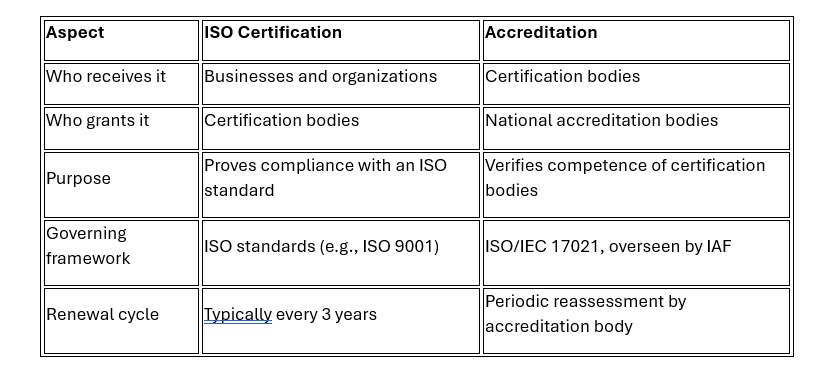
ISO Certification vs Accreditation: A Quick Comparison
Final Thoughts
The debate around ISO certification vs accreditation ultimately comes down to understanding who is being evaluated and by whom. ISO certification confirms that a business follows a recognized standard, while accreditation confirms that the certification body issuing that certificate is itself qualified and trustworthy to do so.
For businesses investing time and money into ISO certification, it is worth the extra step to confirm that the certification body is properly accredited. This single detail can make the difference between a certificate that opens doors to new markets and contracts, and one that carries little practical value. By keeping the distinction between ISO certification vs accreditation clear, organizations can make smarter, more strategic decisions on their path toward quality, compliance, and long-term business credibility.