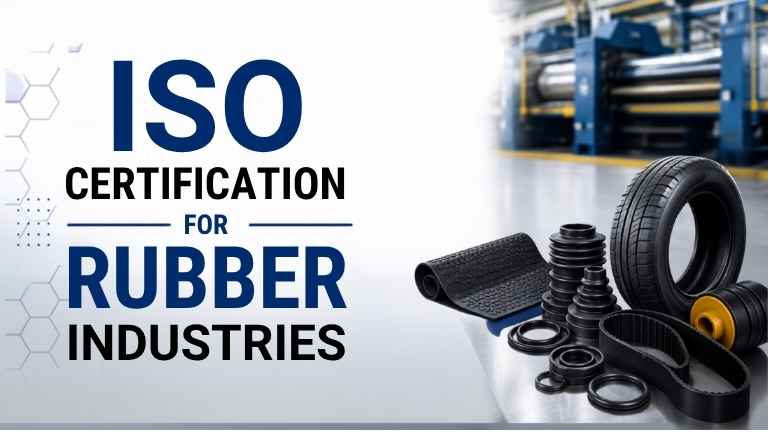
The rubber sector crucially contributes
to providing goods to industries such as automotive, construction, healthcare,
aerospace, electronics, and industrial manufacturing. It produces goods such as
tires, hoses, seals, gaskets, conveyor belts, gloves, and molded rubber
products. Therefore, it is essential to maintain the required level of quality
and safety.
Due to the rising expectations of
customers and competition on the global market, the ISO certification for
rubber industry has become beneficial when manufacturing processes need to be
improved, product quality guaranteed, and customers' trust built.
If you are a manufacturer of small rubber
goods or an industrial rubber processing company, you can only benefit from
obtaining ISO certification.
What is ISO Certification?
ISO certification is a globally accepted
certification that enables organizations to build and maintain robust
management systems either for quality, environmental protection, occupational
health and safety, information security, etc.
ISO certification assists rubber product
making organizations to show their commitment to the standard practices for the
production and quality control of their products.
Why is ISO Certification Important for
Rubber Industries?
The production of rubber goes through
intricate processes, which include the quality of raw materials,
machine-factory-complex, testing, and environmental aspects. Although even
slight errors can make a product run improperly, resulting in a lack of
satisfaction among consumers.
Certifying ISO will enable producers to:
1. Provide quality of their goods
2. Enhance measures of production
3. Cut the amount of defects in
production
4. Decrease the amount of risks in
operations
5. Stick to the required standards and
regulations
6. Build up faith in customers
7. Make their products competitive on the
world market
Benefits of ISO Certification for Rubber
Industries
1.
Enhanced Quality of Products
ISO
standards define processes for production, quality control, and tests that
allow manufacturers to ensure the reliability of rubber products.
Consistent
performance minimizes the number of complaints, improving reputation on local
and international markets.
2.
Improved Control of the Process
Rubber
production includes mixing, molding, vulcanization, finishing, and quality
control.
The
ISO certification facilitates the process of standardization at every stage of
production, which reduces the variability of processes and makes them more
efficient.
3.
Better Customers’ Satisfaction
Customers
tend to choose suppliers that provide consistently high-quality products.
ISO-certified
manufacturers prove their commitment to the quality of the products produced by
them.
4.
More Business Opportunities
Many
government tenders and multinational companies’ suppliers require ISO
certification.
Certification
makes it possible for suppliers to gain more credibility and take part in
bigger contracts.
5.
Lower Waste
ISO
provides organizations with numerous methods of identifying ways to improve
their performance.
These
methods can reduce operating costs, which contributes to higher profits.
6.
Compliance with Regulation Requirements
In
the rubber industry, there are numerous environmental, safety, and quality
regulations.
ISO
certification helps to prepare all the required documentation for audits and
compliance with regulations.
7.
Improved Risk Management
Production
companies are exposed to numerous operational risks, malfunctioning of
equipment and supply disruption problem.
Important
ISO Standards for Rubber Industries
ISO
9001 – Quality Management System (QMS)
ISO
9001 is the most acknowledged standard applicable to rubber manufacturers.
It
emphasizes the following:
- Product
quality
- Customer
satisfaction
- Process
enhancement
- Risk
management
- Continuous
improvement
This
certification suits the manufacturers of tires, industrial rubber products,
rubber compositions, molded components, seals and gaskets, footwear, and
medical rubber products.
ISO
14001 – Environmental Management System
The
rubber manufacturing process is connected with chemical processing, emission,
waste generation, and energy utilization.
- ISO
14001 helps companies:
- Decrease
the impact on the environment
- Manage
industrial waste
- Enhance
the use of resources
- Comply
with ecological standards
ISO
45001 – Occupational Safety and Health Management System
Rubber
production often requires the use of powerful machinery, chemicals, heat
treatment, and dangerous working conditions.
ISO
45001 contributes to the improvement of the safety of workforce by:
- Finding
possible dangers
- Minimizing
work accidents
- Enhancing
security of employees
- Improving
preparedness for emergency situations
ISO
50001 – Energy Management System
Energy
costs form a large portion of the expenses incurred in rubber manufacturing.
ISO
50001 allows companies to:
- Optimize energy usage
- Decrease electricity costs
- Enhance efficiency of equipment
- Assist in sustainability initiatives
ISO
27001 – Information Security Management System
ISO
27001 is of help to the manufacturers dealing with private customer sketches,
supplier data, secret compositions, or digital production models by securing
sensitive business data against cyber threats and unauthorized access.
Who
should obtain an ISO Certification?
ISO
Certificate is beneficial for:
- Companies producing tires
- Rubber sheeting manufacturers
- Manufacturers of rubber hoses
- Producers of industrial rubber goods
- Companies dealing with manufacture of conveyor belts
- Manufacturers of rubber gaskets
- Rubber seals manufacturers
- Rubber molding companies
- Producers of medical rubber products
- Automotive rubber part manufacturers
- Manufacturers of rubber shoes
- Rubber compounds producers
ISO
Certification Process for Rubber Industries
Step
1: Conducting a Gap Analysis
Experts
evaluate the company's current operations and determine what needs to be
changed prior to the introduction of ISO standards.
Step
2: Documentation
The
organization now creates policies, procedures, manuals, objectives for quality,
maps of processes, and the documentation necessary for certification.
Step
3: Implementing the System
The
proposed management system is brought to life resulting in its application in
production, quality control, procurement, maintenance, and administrative
departments.
Training
of personnel is conducted to ensure adequate implementation.
Step
4: Internal Audit
The
internal audit confirms that the implemented system is operating in compliance
with ISO standards.
All
identified non-conformities are fixed before the certification audit.
Step
5: Certification Audit
The
certified auditor performs a detailed audit of the organization`s compliance
with the appropriate ISO standard.
Step
6: Certification
After
receipt of a certificate by the organization, the certificate is valid for
three years with checks of the organization taking place at regular intervals.
Documents
Required for ISO Certification
- Organizational structure
- Quality policy
- SOPs (Standard Operating Procedures)
- Production process documentation
- Quality control documentation
- Employee training information
- Risk assessment reports
- Maintenance record for equipment
- Internal audit reports
- Corrective action reports
- Management review reports
How Long Does ISO Certification Take?
The
specific time for certification is determined by several factors, including:
- The size of the company.
- The number of employees at the company.
- The complexity of the manufacturing process.
- Pre-existing management systems of the company.
- The ISO standard selected.
The
certification process, on average, takes between four and twelve weeks to
complete in the rubber manufacturing industry based on the level of
preparedness.
Why
Choose ISO Certification for Your Rubber Manufacturing Business?
ISO certification is more than simply a
requirement of compliance, it is an investment in long-term business success.
It leads to enhanced product quality, operational efficiency improvement, risk
reduction, and increasing customer trust. By getting certified, rubber
producers that want to grow their businesses on both local and global markets
signal their commitment to global standards and improvements.
Conclusion
ISO Certification is not simply an
indicator of quality; its purpose is to make strategic investments that allow
rubber-producing businesses to improve their efficiency of work, ensure that
customers receive consistently high-quality products, and create long-lasting
trust among customers. By implementing management systems certified by international
organizations, companies will be able to streamline their production processes,
reduce the frequency of defect appearance, cut costs, and comply with the
requirements set by the industry.
Due
to the intense competition present in modern manufacturing markets, more and
more customers as well as international buyers take a keen interest in
suppliers who can prove their commitment to quality, safety, and being
environmentally-friendly. ISO-certified
companies enjoy better credibility, position themselves strongly in the
marketplace, and often receive numerous tenders from governments or
opportunities for international exports.
If you are a small manufacturer of rubber
products of a large industrial enterprise, receiving ISO certification can
present you with a lot of opportunities. Acquiring the necessary certification
is a way to obtain competitive advantages by means of applying recognized
international standards.
FAQs
1.
Which certification is the most suited for rubber industries?
ISO
9001 is the most widely suggested certification since it is dedicated to the
area of quality management and continual progress. Companies may also choose
ISO standards mainly based on the requirements in the business which include
ISO 14001, ISO 45001, ISO 50001, or ISO 27001.
2.
Is it compulsory for rubber manufacturers to get ISO certification?
No.
ISO certification is normally optional. Nonetheless, a large number of clients,
government tenders, exporters, and multi-national clients prefer dealing with
suppliers who are in possession of ISO certification.
3.
Is it possible for small-scale rubber manufacturing companies to have ISO
certification?
Yes.
ISO certifications are generally made available for all types of companies
regardless of their size, hence even startups, MSMEs, and big manufacturing
companies can obtain ISO certifications.
4.
What is the duration of an ISO certification?
An
ISO certification is valid for a period of three years on average; however,
regular audits are performed to make sure it remains valid.
5.
Is there a positive impact of ISO certification on exports?
Of
course. In general, ISO certification increases credibility, assures conformity
to the internationally accepted quality level, and contributes to better
accessibility for the overseas clients.
ALSO READ