Blog Details

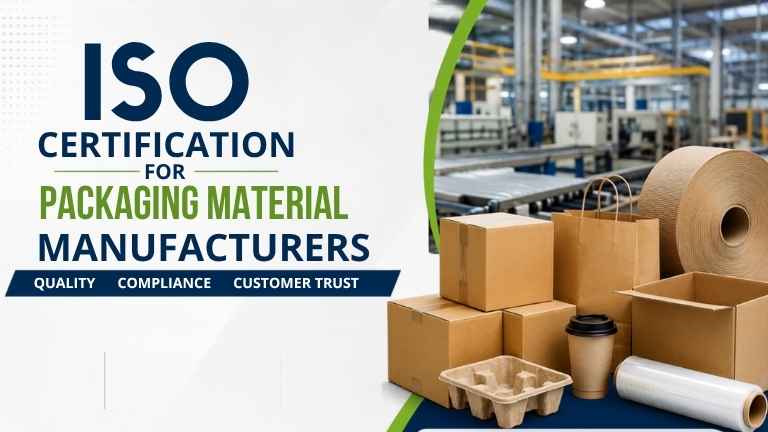
ISO Certification for Packaging Material Manufacturers

The significance of the packaging industry cannot be overlooked as it aids in securing products, enabling them to be delivered safely, building brand perception, and complying with certain regulations. Packaging includes food wrappers, pharmaceutical containers, corrugated boxes, plastic films, glass containers, flexible substrates, paper pouches, and metal containers, hence packaging manufacturers should produce high-quality goods in accordance with specified safety standards.
 
The rise in competition among businesses and the increased expectations of consumers means that the ISO Certification for Packaging Material Manufacturers has become important for any organization. This is a proof of adherence to quality management standards on the international level.
 
Apart from that, ISO Certification not only helps improve the quality of goods but also instills confidence in the consumers and helps industries follow rules and regulations, improve productivity levels and access the global market.

For more infortation consult a leading consultant of ISO Certification in Delhi,
 
What is ISO Certification?
 
The International Organization for Standardization (ISO) is an independent global organization that creates internationally accepted standards in quality, safety, environmental management, information security, health and safety at work, and business processes.
 
Obtaining ISO certification verifies the compliance of a company’s management system with ISO requirements after being conducted by a certification organization.
For packaging producers some of the benefits of having ISO certification include:
  • Quality
  • Consistency
  • Satisfaction
  • Regulatory Compliance
  • Environmental Responsibility
  • Safety
  • Improvement
Why ISO Certification is Important for Packaging Material Manufacturers
 
Adequate packaging ensures the maximum quality of goods, increased product life span, safer transportation and satisfied customers. A flaw in packages can lead to losses, product damage, contamination, dissatisfaction of clients, or even product recalls.
 
ISO certification enables manufacturers to create a consistent production process that reduces risks and improves performance.
 
The certification helps earn clients, retailers, exporters, distributors, and authorities’ confidence.

Types of Packaging Material Manufacturers That Need ISO Certification
 
ISO certification brings advantages to companies which are actively involved in the production of
  • Corrugated boxes
  • Carton boxes
  • Paper packaging
  • Flexible packaging
  • Plastic packaging
  • Food-grade packaging
  • Pharmaceutical packaging
  • PET bottles
  • Glass bottles
  • HDPE containers
  • Metal cans
  • Aluminum foil packaging
  • Labels and stickers
  • Laminated pouches
  • Bubble wrap
  • Stretch films
  • Industrial packaging
  • Export packaging
  • Wooden pallets
  • Eco-friendly packaging materials
Important ISO Standards for Packaging Material Manufacturers
 
ISO 9001:2015 – Quality Management System
ISO 9001 is the standard that has been most widely embraced in the field of packaging manufacturing.
 
The standard applies to:
  • Quality of the product
  • Satisfaction of the customer
  • Improvement of processes
  • Management of risks
  • Monitoring of performance
  • Improvement on an ongoing basis

Benefits of ISO 9001:
  • Uniformity in product quality
  • Reduction of defects in production
  • Quality of documentation
  • Building trust in customers
  • Enhanced efficiency of operation
ISO 14001:2015 – Environmental Management System
When manufacturing packaging, one may use plastic, paper, chemicals, inks, adhesives, as well as the use of energy-intensive processes.
 
ISO 14001 assists in several ways:
  • Reduce the effect on the environment
  • Manage industrial waste
  • Raise recycling levels
  • Reduce pollution
  • Find the best ways for using resources
This certification is very useful for manufacturers of sustainable packaging.
 
ISO 45001:2018 – Occupational Health & Safety Management System
 
Food packaging producers often apply ISO 22000 in order to ensure packaging safety.

ISO 22000 involves:
  • Hazard analysis
  • Risk management
  • Hygiene practices
  • Manufacturing practices
  • Traceability of food
ISO 15378 – Primary packaging materials of medicinal products is favorable for manufacturers of pharmaceuticals packaging.

ISO 15378 consists of:
  • ISO 9001 requirements
  • Good Manufacturing Practices (GMP)
  • Pharmaceutical packaging control
Benefits of ISO Certification for Packaging Material Manufacturers
 
1. Enhanced Product Quality
 
ISO certification allows producers to develop standardized manufacturing operations, which guarantees that each packaging material has a consistent quality level. Fewer defects lead to greater reliability.
 
2. Higher Customer Confidence
 
ISO-certified businesses prove their commitment to quality and continuous improvement. Therefore, customers, distributors, and business partners have a greater probability of making a long-term agreement with certified suppliers.
 
3. Better Compliance with Regulations

ISO standards allow packaging producers to follow the requirements that exist in the industry, including the need for safety compliance to avoid penalties or recalls of products.
 
4. Improved Process Performance
 
By making processes more efficient and introducing standard methods of production, ISO certification allows to cut the inefficiencies of the operations. In general, it can lead to significant improvements in operational activity.
 
5. Decreased amount of waste and production expenses
 
ISO-based quality management enables the businesses to identify inefficiencies in their processes, which allows the producers to reduce the amount of materials involved, rework, and errors during manufacturing, leading to the reduction of costs.
 
6. Strengthened Competitive Advantage
 
Most customers and state structures prefer to work with suppliers that are ISO-certified. Certification helps to enhance the company’s credibility and increase competitiveness in tenders.
 
7. Greater Potential for Exports
 
Those who work internationally often need their suppliers to comply with worldwide quality standards. Receiving ISO certification enhances the reputation of any company, making it easier to penetrate markets in various parts of the world.
 
8. Enhanced Risk Management
 
Following ISO standards promotes the identification of risks involved in manufacturing and enforcement of prevention measures, which leads to a decrease in disturbances and improvement in product consistency.
 
9. Enhanced Productivity of Employees
 
The presence of clear protocols, continuous training, and uniformity of methods makes the work of employees easier, resulting in increased efficiency.
 
10. Increased Satisfaction of Customers
 
Constant quality of goods, timely delivery, and efficient complaints handling result in higher satisfaction level of customers.
 
11. Better Supplier Management
 
Being accredited with ISO will allow for a systematic evaluation of suppliers and careful monitoring of their actions. Higher reliability of the suppliers will result in better quality of inputs.
 
12. Enables Green Production Processes
 
ISO 14001 and other similar standards assist the factories in minimizing harm to the environment as they allow them to manage waste more efficiently and reduce environmental impact.

Documents Required

Common documents include:
  • Company Registration Certificate
  • GST Registration
  • PAN Card
  • Factory License
  • Manufacturing Process Details
  • Product List
  • Organization Chart
  • Quality Manual
  • SOPs
  • Calibration Records
  • Internal Audit Reports
  • Management Review Records
  • Employee Training Records
  • Customer Complaint Records
  • Risk Assessment Documents
Challenges Solved by ISO Certification

Various challenges plague packaging manufacturers like:
  • Product rejection
  • Printing errors
  • Inconsistent material
  • Late delivery
  • Customer complaints
  • Compliance problems
  • Poor docs
  • High wastage
ISO certification helps to solve these issues according to a systematic plan.
 
Industries Served by Certified Packaging Manufacturers

  • Packaging producers frequently encounter the following issues:
  • Rejection of products
  • Inaccuracies in printing
  • Material inconsistencies
  • Delay in delivery
  • Complaints received from customers
  • Problems with compliance
  • Insufficient documentation
  • High rate of waste
  • Variation in processes
ISO certification offers organised answers to resolve these issues
 
Why Customers Prefer ISO-Certified Packaging Manufacturers
 
Customers are preferring suppliers with ISO accreditation because they provide the following advantages:
  • Reliability in product quality
  • Consistency in production
  • Enhanced tracking of production
  • Reduced risk in business dealings
  • Rapid issue resolution
  • Compliance with regulations
  • Strong quality management systems 
These characteristics lead to customer loyalty and satisfaction.

Future of ISO Certification in the Packaging Industry
 
The trends in packaging include the use of environmentally conscious materials, recyclable packaging, and advancements in technologies such as intelligent packaging and automation. Companies that implement International Organization for Standardization (ISO) protocols are able to satisfy customer demands and obligations to the governing bodies.
 
ISO certification gives a business an advantage for improving the quality of products and minimizing ecological damage while keeping business operations cost-efficient and competitive.
 
Investing in management systems backed by ISO certification ensures business prosperity.
 
Conclusion
 
Acquiring ISO Certification for Packaging Materials Producers goes beyond just meeting legal requirements, as it is also considered to be a smart investment for quality, efficiency, and growth. By utilizing the internationally recognized management systems, companies can achieve consistent products, minimize waste, improve customer loyalty and discover new opportunities.
 
No matter whether you produce paper, plastic or flexible packaging, certification ISO signifies your commitment to excellence and advancement.
 
FAQ
 
1.  What is the best ISO certification for manufacturing packaging products?
 
ISO 9001:2015 is the best certification because it deals with quality management. Other ISO certifications like ISO 14001, ISO 45001, ISO 22000, or ISO 15378 can also prove useful based on specific industries.
 
2. Is it obligatory for packaging manufacturers to have ISO certificates?

ISO certification is a choice but it is a requirement that many customers, government projects and international firms seek suppliers with ISO certification.
 
3. For how many years is an ISO certificate valid?
 
An ISO certificate is valid for three years after which it needs to go through the auditing process. 
 
4. Can small packaging companies get ISO certification?
 
Yes. The ISO structure can be implemented by small and medium-sized packaging manufacturing companies to gain from its advantages.
 
5. Does ISO certification increase export capabilities?
 
ISO certification helps exporters because the organization that has ISO certification is more attractive for international clients.
 
6. Which documents are needed to obtain ISO certification for packaging materials manufacturing companies?
 
Typically, the documents include the registration certificate of your business, GST registration, PAN registration of the company, factory license, the manual for quality, standard operating procedures, organogram, flow diagram of the process, employee training records, internal audit report, and management record of ISO certification.
 
7. What is the cost of ISO certification for packaging materials manufacturing companies?
 
The ISO certification cost depends on several aspects, such as organization size, number of employees, certification coverage, number of production sites, and the certification body. Usually, companies that are considered small pay less for the certification than big companies.
 
8. Can packaging material manufacturers obtain multiple certifications for ISO?
 
Yes. Many manufacturing companies follow various standards related to ISO by implementing them. For instance, a company can get ISO 9001 certification for quality management, ISO 14001 certification for environmental management, and ISO 45001 certification for health and safety at work.
 
9. How and when ISO audits will be conducted after getting the ISO certificate?
 
When an ISO certificate is obtained for a company, the company will have to undergo annual compliance audits through surveillance.
 
10. What role does ISO certification play in enabling packaging material producers to secure more contracts?
 
ISO certification boosts a company’s credibility by showcasing its commitment to quality, compliance, and constant growth. This attracts many government agencies, multinational companies, exporters, and big individual companies to cooperate with ISO-certified manufacturers boosting their business chances and trust from clients.

ALSO READ

For Quick Call Fill Out the Enquiry Form